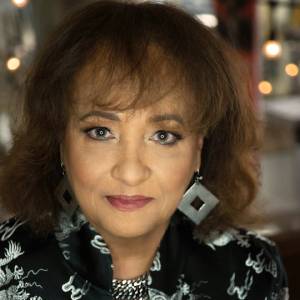
Daphne Maxwell Reid is an actress, designer, photographer, author, former model and creative whose career has crossed television, film, fashion and visual art. She is widely recognized for portraying Vivian Banks on The Fresh Prince of Bel-Air, stepping into one of television's most familiar family roles and bringing her own personality and interpretation to the character rather than attempting to imitate the performer who came before her.
But Reid's story reaches far beyond Aunt Viv. She originally studied interior design and architecture before modeling opened an unexpected path into commercials and acting. Over the years, that same curiosity has continued through photography, international travel, writing, fashion design and other creative pursuits. Rather than building her identity around one accomplishment, Reid has continued exploring what she can learn, create and contribute.
Her conversation with The Chris & Sandy Show reveals a woman who views life as a continuing journey of preparation, discovery and growth. Whether discussing acting, marriage, creativity, rejection or legacy, Reid repeatedly returns to a simple principle: understand your own gifts, remain open to opportunity, and don't spend your life trying to become somebody else.
Daphne Maxwell Reid Built a Life Bigger Than Any One Role
The actress millions know as Aunt Viv reflects on an unexpected career, four decades of marriage, a restless creative spirit and why becoming yourself matters more than following someone else's path.
Millions of people know Daphne Maxwell Reid because she walked into the Banks family home and became Vivian Banks on The Fresh Prince of Bel-Air. For a generation of viewers, her face is connected to one of television’s most recognizable families and one of the defining sitcoms of the 1990s. But ask Reid when she knew she wanted acting to become her career and the answer is nothing like the polished origin story you might expect from someone with decades of television and film credits.
“It hasn’t happened yet,” she joked during her May 2022 appearance on The Chris & Sandy Show.
There was humor in the answer, but also truth. Reid did not grow up plotting a path toward Hollywood. She studied interior design and architecture, moved into modeling, picked up commercial work and eventually found herself acting. Looking backward, the progression can seem almost inevitable. Living it, Reid said, was something else entirely—a combination of opportunity, professionalism and preparation. She prepared herself for where she was without pretending she knew exactly where it would lead.
That willingness to follow opportunity without demanding a complete map may be one of the clearest threads running through Reid’s life. Her path into entertainment began while she was still in college, when modeling offered a way to make money. Commercials followed, and then actor Robert Conrad came to Chicago for a television project and hired her for a role. Acting had not been the childhood destination. In fact, Reid remembered not seeing many examples of Black women making a living as actresses, which made the possibility harder to imagine in the first place.
Yet when opportunities appeared, she was ready enough to step into them. Reid’s story is not so much about finally arriving at the place she always knew she belonged as it is about repeatedly discovering that her life could become larger than she had imagined.
Becoming Aunt Viv Without Becoming Someone Else
Eventually came the role that would make Reid recognizable to millions. She joined The Fresh Prince of Bel-Air after Vivian Banks had already been established by another actress, entering a situation that could easily have been dominated by comparison. There was an existing performance, an existing audience and an existing idea of who Aunt Viv was supposed to be.
Reid’s approach was refreshingly uncomplicated: she could only do what she did.
She was not trying to recreate another actress’s performance. The woman who came before her had her own talents and interpretation; Reid had hers. The producers hired her to bring what she brought. That confidence surfaced again during the interview when Chris and Sandy discussed the way viewers still sometimes choose a favorite version of Aunt Viv. Reid did not seem particularly bothered by the debate. People were entitled to their preferences. Their preference did not change who she was.
There is something bigger than television in that perspective. Much of modern ambition is built around studying the people who arrived first: the successful entrepreneur, the popular host, the bestselling author, the creator with the enormous following. Learning from someone else can be valuable. Losing yourself while trying to reproduce them is something different. Reid’s career suggests a quieter kind of confidence—the ability to respect what came before you without believing your job is to become a copy of it.
That same groundedness showed up when she talked about working on a set. Reid did not see the actor as the center of everything simply because the actor was the face audiences recognized. Early in her career, she paid attention to the people working around her. What did the lighting crew need? What did the sound department need from her? What could she learn about the process beyond her own lines?
“It’s a team effort, and it ain’t all about you,” she said.
For someone whose career put her in front of the camera, Reid developed an appreciation for the machinery behind it. The actor may be on the poster, walk the red carpet and sit for the interviews, but hundreds of people can contribute to what eventually reaches the screen. That curiosity made her a better collaborator, but it also reflects something broader about the way she approaches life: she wants to understand how things work.
Reid describes herself as someone who loves the journey of learning, and that curiosity has carried her far beyond acting. It also shaped the way she thinks about talent and opportunity. Hollywood, she pointed out, is full of remarkably talented people who never get the role. Some may be more talented than the person who does. Timing matters. Access matters. What a director or writer imagines for a character matters. Sometimes the stars simply do not align.
That does not mean the person who was passed over lacked ability.
Reid’s explanation of casting offers a useful distinction far beyond entertainment. A creator may have a particular person in mind for a role, and an excellent actor may simply not fit that picture. Yet people often translate rejection into something much harsher: I wasn’t good enough.
Those are not the same thing.
There are times when rejection contains useful information and times when improvement is necessary. But Reid’s perspective offers permission not to turn every closed door into a verdict on identity. Sometimes another person was simply a better fit for that particular room, on that particular day, for that particular need.
A Life Willing to Change Direction
When Chris asked about sacrifice and struggle, Reid became more personal. She spoke about the end of her first marriage and described herself as someone who had been ready to move and grow. From there, the conversation widened into a philosophy about choices. Every decision takes us down a path, she said, and not every path turns out to be a good one. If you realize you are headed in the wrong direction, get off the path and change direction.
Reid is adventurous by temperament. She talked about being ready for the next challenge, the next journey and the next thing to learn. That does not mean she sees every pivot as easy or painless. It means she refuses to believe that consistency is automatically the same thing as wisdom. A decision made years ago does not become a life sentence simply because you once believed in it.
That willingness to evolve also appears in her marriage to actor and filmmaker Tim Reid. At the time of the interview, the couple had been married 42 years. Asked how two busy creative people had managed a relationship through decades of careers, projects and change, Reid did not reach for a sentimental slogan. She said you take it day by day and acknowledged that the relationship itself can be the hardest part.
What followed was one of the most thoughtful stretches of the interview. Two people, Reid explained, do not stop growing when they marry. Their interests change, careers develop, ambitions move and understanding deepens. A long relationship has to make room for that. The foundation, she said, is love, respect and support—along with the willingness to remain interested in the person your spouse continues becoming.
Chris recognized his own marriage in that idea. He told Reid about Sandy supporting his dreams and how he later chose to invest in her dream of songwriting. That pursuit eventually contributed to experiences and relationships that helped shape The Chris & Sandy Show. Reid’s response was simple: “That’s how you stay together.”
Not by becoming identical. Not by freezing each other in place. By taking one another’s passions seriously enough that both lives have room to expand.
The Details Between Here and There
Perhaps the most unexpected window into Reid came when the conversation turned to doors.
She photographs them around the world.
At first, that sounds like an interesting artistic niche, one of several creative pursuits in a life that has also included fashion, writing and design. But for Reid, the doors carry a larger idea. People spend so much of life trying to move from Point A to Point B that they often overlook what lies between them. The graduation, the promotion, the house, the next booking or the next milestone becomes the destination, while the details of the journey fade into the background.
Reid wants people to notice those details: architecture, workmanship, food, culture, relationships and the way people live. International travel has been part of her personal growth because it exposes her to lives and traditions different from her own. Her photography becomes less about collecting pictures than training the eye to pay attention.
“Life is all around you,” she said.
For Reid, even the act of photographing a door becomes an invitation to notice what is happening while we are busy going somewhere else. She pushed back against the idea that constantly viewing life through a phone is the same thing as experiencing it. Absorb what you can while you are passing through, she urged, because you only pass through once.
That philosophy helps explain the range of Reid’s creative life. Acting did not cancel photography. Photography did not cancel fashion. Fashion did not replace writing or travel. Her interests seem less like unrelated side projects than different expressions of the same instinct: notice something, learn about it and create from it.
Her fashion work, Daphne Style, grew in much the same way. Reid made one-of-a-kind pieces for herself, including coats from Chinese silk brocade, and people began stopping her to ask where she had bought them. She had made them herself. Encouragement from her husband eventually led to a fashion line, with her pieces appearing in shows and being purchased off the runway. During the pandemic, the same instinct turned toward designer masks, including custom work for nonprofit organizations that used them in fundraising.
The pattern repeats throughout her story. She gets interested. She learns. She makes something. Then another door opens.
Even the question of who helps manage all of this produced a characteristically straightforward answer. Reid had an agent and sometimes a publicist when work required one, but much of her life and creative work she handled herself: household responsibilities, sewing, photography, computer work, press and social media. She admitted with a laugh that impatience was partly responsible. By the time she trained someone to do something, she figured she could already have done it herself.
It was not a polished answer about leadership. It was simply honest—and that authenticity may be one reason the conversation feels as fresh as it does.
The Legacy Beyond Aunt Viv
Late in the interview, Chris asked where Reid wanted to be five years later. Her first answer was somewhere on an island in the sun, or perhaps traveling. Then she admitted she really did not project that far ahead. The previous two years had shown how quickly an entire life could change. She had come through them well enough and was content to see what happened next.
It is a fitting answer from someone whose life was never built according to a rigid map. The architecture student did not know television was coming. The model did not know where commercials would lead. The actress accepting another role could not know that Vivian Banks would become part of television history. Reid has spent much of her life preparing without pretending to know precisely what she is preparing for.
But perhaps the clearest indication of what matters to her came when Chris asked how she wanted to be remembered.
She could have pointed to the career. She could have talked about television history, modeling, fashion, photography or the many creative projects that have filled her life.
Instead, she hoped people would say she was kind. That she helped. That she had a great smile.
A few minutes later, she said she hoped she would never forget that people are people and that relationships are among the greatest treasures in life.
Then came the line that seemed to gather the entire conversation into a single idea.
Asked what advice she would give someone who wanted to do what she does, Reid first joked that they should be careful what they ask for. Then she became serious. She believes God gave her many talents, she said, and she tries to manifest those gifts in a way that honors what she has been given.
But nobody listening should try to become Daphne Maxwell Reid.
“You don't want to be me. You want to be all of you.”
Recognize your talents. Explore your gifts. Develop them and use them because they are part of what makes you uniquely yourself.
It is difficult to imagine a better ending to a conversation that began with one of television’s most recognizable characters. The interview starts with Aunt Viv and eventually arrives at identity. Reid’s life has been filled with roles, but her advice is not to spend yours auditioning to become someone else.
Learn. Prepare. Stay curious. Change direction when the road no longer makes sense. Give the people you love room to grow. Notice what is happening between destinations. Use what you have been given.
And whatever doors eventually open, walk through them as yourself.
7 LESSONS FROM DAPHNE MAXWELL REID
LESSON 1
Prepare for a Future You Cannot Predict
One of the most liberating ideas in Daphne Maxwell Reid's story is that you don't have to know exactly where you're going in order to prepare yourself well.
She entered college studying interior design and architecture. Modeling emerged. Commercial work followed. Acting appeared. Television became part of her life. Eventually, one role connected her permanently to one of the best-known sitcoms of its era.
Looking backward, the sequence seems logical.
Living forward, it wasn't.
That distinction matters because people often delay action while waiting for certainty.
They believe they need the perfect business plan, the perfect career map, the perfect calling, the perfect next step.
Reid's career suggests another possibility.
Prepare yourself.
Become professional.
Learn.
Stay curious.
Take opportunities seriously.
Then allow life to reveal destinations you couldn't yet see.
Preparation and prediction are not the same thing.
You can become ready without knowing exactly what you're getting ready for.
That is useful in careers, relationships, entrepreneurship and creative work.
Sometimes the opportunity that changes your life will not be the opportunity you were preparing to receive.
But what you learned while preparing may still be exactly what allows you to receive it.
LESSON 2
Someone Else's Version Doesn't Have to Become Yours
Walking into an established role is difficult.
Walking into a role audiences already associate with another performer creates another level of pressure.
Daphne Maxwell Reid's response was refreshingly simple.
She wasn't the other actress.
She couldn't perform the role exactly as someone else had.
She could only bring herself.
That principle applies almost everywhere.
The world is full of successful examples.
Successful podcasters.
Successful entrepreneurs.
Successful authors.
Successful parents.
Successful marriages.
Successful ministries.
Successful creators.
Successful speakers.
We study them because studying success can teach us.
The danger comes when learning becomes imitation.
There is a difference between asking:
"What can I learn from them?"
and asking:
"How do I become them?"
Reid's later advice brought the idea full circle.
You do not want to become her.
You want to become fully you.
The healthiest form of inspiration doesn't erase identity.
It reveals possibility.
LESSON 3
Rejection and Inadequacy Are Not the Same Thing
Few industries demonstrate rejection more visibly than acting.
Someone auditions.
Someone else gets the part.
It is tempting to turn the result into a ranking.
They were better.
I wasn't good enough.
Reid explained why that isn't always how casting works.
A writer, director or producer has an image of a character.
You might be extraordinarily talented and still not resemble what they imagined.
The rejection is real.
But the conclusion people often attach to it may be false.
This distinction has enormous emotional consequences.
Imagine how differently you respond to disappointment when the internal message changes from:
"I wasn't good enough."
to:
"That opportunity wasn't my fit."
Sometimes you do need to improve.
Sometimes a rejection contains valuable feedback.
But emotional maturity requires resisting the impulse to make every "no" mean something universal about your worth.
One opportunity can reject you without life rejecting you.
One audience can overlook you without proving you have nothing to say.
One door can stay closed while another is still being built.
LESSON 4
Healthy Relationships Leave Room for Growth
Reid's marriage insight may be one of the richest parts of the conversation.
Long-term love is often portrayed as two people remaining perfectly aligned forever.
Real life doesn't work like that.
People change.
The person you marry at 25 will not be precisely the same person at 45, 65 or 85.
Neither will you.
Reid said both people grow according to their individual development.
The goal isn't to prevent that growth.
The foundation is love, respect, trust and support.
There is something profound in the idea that a healthy spouse doesn't merely love who you were when they married you.
They develop the capacity to remain curious about who you are becoming.
And they don't require your growth to threaten their own.
Chris and Sandy's story during the interview reinforced the point.
Sandy supported Chris's dreams.
Later, Chris intentionally turned toward Sandy's dream of songwriting.
That pursuit eventually contributed to experiences and relationships that helped shape what later became The Chris & Sandy Show.
Supporting someone else's dream doesn't always pull you away from your own story.
Sometimes it expands the story you eventually share.
LESSON 5
The Details Between Destinations Are Your Life
Daphne Maxwell Reid photographs doors.
On the surface, that sounds like an interesting artistic niche.
But her explanation transformed it into something much larger.
People spend life traveling between Point A and Point B.
We concentrate on departure and arrival.
The degree.
The job.
The wedding.
The promotion.
The business.
The house.
The retirement.
The next goal.
Yet most of life doesn't happen at the moment of arrival.
It happens between destinations.
Reid wants people to notice those details.
Different cultures.
Food.
Architecture.
Craftsmanship.
Relationships.
The surrounding world.
She warned against confusing looking at life through a phone with actually living it.
That message has only become more relevant.
A person can document almost every moment while experiencing surprisingly little of it.
Presence requires something harder than capturing a picture.
It requires paying attention.
One day, the milestones become memories too.
The question becomes whether we remember anything that happened between them.
LESSON 6
Gifts Are Meant to Be Explored, Not Merely Identified
Reid doesn't fit neatly inside a single professional label.
Actress.
Model.
Designer.
Photographer.
Author.
Fashion creator.
Traveler.
Creative entrepreneur.
The temptation is to ask which one is the "real" Daphne.
Her interview suggests that the question itself may be flawed.
She believes God gave her multiple gifts.
Her responsibility is to manifest those gifts as well as she can.
That offers a meaningful alternative to a culture obsessed with identifying one singular calling.
Some people do experience one dominant vocation.
Others contain several interests that come alive during different seasons.
The presence of multiple gifts doesn't necessarily mean someone lacks focus.
It may mean their life requires a wider canvas.
Reid follows curiosity.
Photography becomes books.
Photographs become products.
Fabric becomes clothing.
Clothing becomes wearable art.
A pandemic creates a need, and sewing becomes masks that can also benefit nonprofit organizations.
One gift doesn't have to invalidate another.
Sometimes purpose isn't one job title.
Sometimes purpose is the way you repeatedly use whatever is in your hands.
LESSON 7
The Greatest Legacy May Have Nothing to Do With Your Greatest Achievement
Imagine spending decades building a recognizable career.
Imagine millions knowing your face.
Imagine being permanently connected to television history.
Then someone asks how you want to be remembered.
Reid didn't lead with any of it.
She wanted to be remembered as kind.
As someone who helped.
As someone with a great smile.
There is an important difference between achievement and legacy.
Achievement can be measured externally.
Awards.
Credits.
Revenue.
Audience.
Titles.
Records.
Recognition.
Legacy is more difficult to measure because much of it lives inside other people.
How did they feel around you?
Did you help?
Did you encourage?
Did you treat them as though they mattered?
What happens to the room when your name comes up after you are gone?
Reid also said she hoped never to forget that people are people and that relationships are among life's greatest treasures.
Perhaps that is why her legacy answer makes so much sense.
After a lifetime in an industry built partly on visibility, she returned to relationship.
The achievement may introduce your name.
Character determines what people say after they hear it.
THE SINGLE BIGGEST LESSON FROM THIS INTERVIEW
Become Fully Yourself
If someone remembers only one lesson from Daphne Maxwell Reid's conversation five years from now, it should be this:
Your life is not an audition to become somebody else.
That theme appears repeatedly even before Reid states it directly.
She didn't build her career by following a perfectly predictable map.
She didn't enter Fresh Prince trying to reproduce another actress's performance.
She didn't allow acting to become the only expression of her creativity.
She didn't demand that her husband remain unchanged throughout a decades-long marriage.
She didn't insist that the next five years conform to an elaborate plan.
And when asked how somebody could become like her, she rejected the destination.
Don't become Daphne.
Recognize what is inside you.
Develop it.
Honor it.
Use it.
That idea pulls nearly the entire conversation together.
Preparation matters because it develops your capacity.
Authenticity matters because it protects your identity.
Marriage requires room for both identities to grow.
Creativity gives gifts somewhere to go.
Presence allows you to experience the life you're actually living rather than the life you're comparing it with.
Legacy becomes the imprint your particular life leaves on other people.
There will always be someone whose career looks larger.
Whose platform looks bigger.
Whose opportunity arrived sooner.
Whose path seems easier.
Whose success tempts you to copy the blueprint.
Reid's answer is far more difficult—and far more freeing.
Find out what you were given.
Then become responsible for that.
TOP 5 QUOTES
1. "You don't want to be me. You want to be all of you."
2. "Recognize your talents, your gifts, and explore them."
3. "It's a team effort, and it ain't all about you."
4. "You gotta go all in. You sit on the sidelines, you get nothing done."
5. "Your relationship with people is the most treasured thing that you can ever have."
About The Chris & Sandy Show
The Chris & Sandy Show uses entertainment as the doorway into conversations about the people behind public accomplishments.
The show explores the stories beneath success—the struggles, relationships, choices, resilience, faith, growth and lessons that often remain hidden when conversation stays focused only on the latest project.
The May 9, 2022 conversation with Daphne Maxwell Reid is a strong example of that mission.