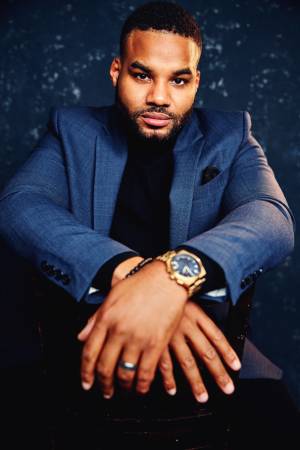
Mark McKinnon is an actor, acting coach and founder of McKinnon Acting Studio whose career has included roles across television and film. A former athlete who once dreamed of playing professional football, McKinnon discovered acting unexpectedly in high school and went on to study Theatre Arts at Howard University. His credits have included recurring roles on Blue Bloods and FBI, appearances on The Blacklist, Gotham and Veep, and selection for the 2020 ABC Discovers Showcase. He also starred in the BET Her film The Waiting Room, directed by Sheryl Lee Ralph, and The Available Wife.
Beyond his own work in front of the camera, McKinnon has invested in developing other actors through McKinnon Acting Studio in Prince George's County, Maryland. His journey has been shaped not only by the roles he has landed, but by the lessons learned through rejection, financial uncertainty, family, mentorship and faith. He has spoken openly about learning to separate his identity from his career and discovering that becoming a stronger actor required becoming more comfortable with who he was rather than constantly trying to become someone else.
In his conversation with The Chris & Sandy Show, McKinnon shared a perspective on success that reaches well beyond entertainment. He credited his wife, Brittney, and the people behind him for helping sustain the journey, while reflecting on the difficult seasons he never wants success to make him forget. His philosophy can be summed up in one of the conversation's most memorable lines: "The higher you go, the more responsibility you have." For McKinnon, success isn't simply about how far you rise, but what you're able to give, who you're able to help and the person you become along the way.
Mark McKinnon Learned That Becoming a Better Actor Started With Becoming More Himself
From Howard University to BET, Blue Bloods and Gotham, Mark McKinnon's journey has been about more than landing roles. Along the way, he learned about identity, marriage, faith, balance and what success should really mean.
There was a time when Mark McKinnon could almost measure how he felt about life by how well his acting career was going.
When the auditions were coming and the work was happening, life felt good. When the opportunities slowed down, everything seemed to slow down with them. McKinnon remembers the depression, the financial pressure and the reality of being the struggling actor trying to figure out how to keep pursuing something he loved while also trying to survive.
Eventually, even the way he walked into auditions began to change. Instead of being able to think solely about the character and the work, another question followed him into the room: How much does this pay? Could this role get him through another month or two?
Acting wasn't simply something McKinnon loved anymore. It was becoming responsible for too much of his life.
Then, around 2014, he made a change. He began paying more attention to balance. Family mattered. His finances mattered. The rest of his life mattered. Acting was still important—very important—but it no longer had to be everything.
"It was just a puzzle piece of my life," McKinnon told Chris and Sandy. "It wasn't everything."
And then something unexpected happened.
His acting career began to grow.
It is one of the most revealing parts of McKinnon's conversation with The Chris & Sandy Show, because the story behind his success isn't simply about working harder, landing the right audition or meeting the right person. It is about a man learning that he could pursue his dream without requiring that dream to tell him who he was.
The Athlete Who Accidentally Found a Stage
Acting wasn't McKinnon's childhood plan. Growing up in Waldorf, Maryland, he dreamed of playing professional football. He was an athlete, and that was the world in which he saw himself.
Then, during his junior year of high school, he went along to support a friend who was auditioning for a production. A drama teacher who knew McKinnon encouraged him to audition too.
He resisted. Theater wasn't really his thing. He was an athlete.
Eventually, though, he agreed to give it a shot. If anything came from it, he figured maybe he'd get a small part.
Instead, he landed a lead role.
Some of his friends from football and basketball came to see the show, and McKinnon remembers them laughing at the sight of him singing and dancing onstage. But something happened the following year that mattered far more than the laughter.
More Black students came out to audition.
For McKinnon, that changed the meaning of what he had done. By being willing to step into a place where people didn't necessarily expect to see him, he may have helped someone else see that place differently too. Acting was no longer simply something he had unexpectedly discovered he enjoyed. He saw that it could have an impact.
That realization helped change the direction of his life. McKinnon went on to study Theatre Arts at Howard University in Washington, D.C., eventually building a career that would span television, film, coaching and casting.
His professional credits would grow to include recurring work on Blue Bloods and FBI, along with appearances in The Blacklist, Gotham and Veep. He was also selected for the 2020 ABC Discovers Showcase and founded McKinnon Acting Studio in Prince George's County, Maryland, where he has helped other actors prepare for professional opportunities.
But before the résumé grew, McKinnon had to learn how to survive the years when it wasn't growing fast enough.
When the Dream Gets Too Heavy
There is a version of chasing a dream that looks good from the outside. Go all in. Sacrifice. Give it everything. Refuse to quit.
McKinnon discovered there can also be another side.
When acting became everything, the highs and lows of the industry became his highs and lows too. A good stretch professionally could make him feel great. A drought could send him in the opposite direction.
He described being broke. He talked about depression. He knew the "starving artist" experience firsthand.
That's why his decision to create more balance wasn't about abandoning the dream. It was about putting the dream back into its proper place.
The change also affected how McKinnon approached rejection. His faith gave him another way to look at opportunities he didn't receive.
"If this is for me, it's for me," he explained.
If an opportunity wasn't his, he could consider the possibility that perhaps God was protecting him from something or that he simply wasn't ready for it yet. He still had to prepare. He still had to audition. He still had to work. But he didn't have to make every outcome a verdict on his worth.
There is a difference between giving everything you have to your calling and asking your calling to become everything you are. McKinnon had begun learning that difference.
The Actor Who Learned to Become More Himself
Ironically, one of the biggest lessons acting taught McKinnon was how to stop trying so hard to become somebody else.
Earlier in life, that had been part of the attraction. McKinnon admits he wasn't particularly confident in who he was. The young man who would eventually work professionally in front of cameras was once so uncomfortable speaking publicly that he would rather take an F than stand in front of the class and give an oral book report.
Acting gave him permission to step into someone else's identity.
But as McKinnon matured and spent more time working and training for the camera, his approach changed.
If he were playing a doctor, for example, he no longer needed to manufacture an idea of how a doctor was supposed to walk, talk and behave. The more useful question became much simpler:
"How would Mark McKinnon be with a white coat on?"
It is an acting lesson, but it's also a revealing statement about his personal growth. The profession that once allowed an insecure young man to hide inside other people eventually required him to become comfortable bringing more of himself into the room.
His strongest performances didn't require erasing Mark McKinnon.
They required knowing him.
That growing confidence made certain professional moments even more meaningful. McKinnon had grown up a Batman fan, so when he eventually found himself working on Gotham, the experience carried an almost surreal quality. It was an overnight shoot, surrounded by the darkness, fog and characters associated with that world, and at some point the realization hit him.
He wasn't sitting at home watching this.
He was in it.
This was network television. He had auditioned and earned his place there.
It was one of those rare moments when years of hoping, struggling and working suddenly become tangible.
When a Role Becomes Personal
Some roles, however, required McKinnon to reach into places much deeper than childhood dreams.
His lead role in the BET Her film The Waiting Room, directed by Sheryl Lee Ralph, was one of them. The film follows women confronting the possibility and reality of breast cancer, a subject that carried personal weight for McKinnon.
His grandmother had died from breast cancer, and McKinnon said the role forced him to reopen emotions he had pushed away. His professional biography at the time also noted that he dedicated the role to both his grandmother and his father, who died from prostate cancer.
Yet the character also felt unusually familiar in another way. McKinnon saw pieces of himself—and of his own marriage—in Derek, the man he played.
There were moments when he didn't feel as though he needed to "act" much at all.
When he later watched the film, he wasn't watching himself create some distant character. In many ways, he was watching himself simply be.
The project also placed McKinnon under the direction of Ralph, someone he had watched on television while growing up. Now a person he once knew through a screen was directing him, teaching him and helping draw out his performance.
Those are the moments audiences see.
The credit.
The film.
The finished performance.
But McKinnon's story also contains all the people and moments that never appear on the screen.
The People Behind the Name in the Credits
When Chris asked McKinnon about the team behind his career, the first person he named wasn't his manager or an agent.
It was his wife, Brittney Carter McKinnon.
She was the person willing to sit up at one or two in the morning reading lines with him, sometimes barely able to keep her eyes open. She was also someone who knew Mark well enough to recognize when he was drifting too far from himself and help bring him back.
When his career required him to spend a season in New York while the life they had built remained in Maryland, McKinnon expected there could be resistance.
Instead, Brittney supported him.
They talked every day. She visited. During some of the difficult mental and emotional stretches that came with pursuing acting, she spoke life into him.
McKinnon also credited his manager, his agents and two spiritual mentors who became father figures in his life. His own father had not been present while he was growing up, an absence McKinnon acknowledged had also given him emotional experiences he could draw from when portraying characters dealing with fatherlessness.
The conversation about Brittney opened the door to one of the most personal stretches of the interview. Chris shared how Sandy had stood beside him through the addiction that marked the first years of their marriage and how her love helped him understand something about the love of God.
The conversation moved away from television entirely.
It became husbands talking about marriage, wounds, expectations and what it means to have somebody beside you who can see more in you than what you're currently going through.
For McKinnon, Brittney's role went beyond supporting an acting career. During one particularly low season, he recalled her taking him to Haggai chapters 1 and 2 and the rebuilding of the temple. The passage spoke to something deeper than professional success: the possibility that things can look good materially while something inside still needs rebuilding.
That distinction seems to run throughout McKinnon's story.
The question wasn't simply whether he could build a successful acting career.
It was who he would become while building it.
Remember the Nights When You Had Nothing
Near the end of the conversation, Chris asked McKinnon a question that moved beyond the next role, the next audition and even his five-year plan.
Imagine it is 15 years from now.
Imagine the career has worked.
Imagine success has arrived on a grand scale.
What would the Mark McKinnon sitting here today want that future version of himself to remember?
McKinnon's answer went immediately back to the difficult years.
"Remember those nights when you cried. Remember those nights when you had nothing."
Remember the struggle. Remember what it felt like to wish someone would simply come along and bless you.
Then he turned the memory outward.
If future success eventually gave him the resources and ability to walk into someone's ordinary day—even encountering someone in a grocery store—and unexpectedly become the blessing he once wished someone would be for him, he wanted to do it.
"The higher you go, the more responsibility you have."
It may be the most important sentence of the entire conversation.
McKinnon wasn't imagining success simply in terms of what it could give him. He was imagining what success could make him capable of giving someone else.
That is a very different definition of making it.
More Than the Next Role
At the time of his conversation with The Chris & Sandy Show, McKinnon still had plenty of professional ambition.
He wanted McKinnon Acting Studio to become known for developing an exceptional crop of actors. He envisioned becoming a series regular on television, perhaps even finding a role that could combine his love of acting and sports. He wanted family and children to be part of the future he was building.
He hadn't stopped dreaming.
He had simply learned that the dream needed to fit inside a life larger than itself.
That may be what makes McKinnon's story worth returning to years after the projects that originally brought him onto the show.
The titles change. The next role eventually becomes an old role. Premieres become memories, and today's career milestone eventually becomes another line in a biography.
The deeper questions remain.
Can you pursue something passionately without allowing it to determine your worth?
Can you become successful without forgetting the people who stood beside you before anyone else knew your name?
Can you remember difficult seasons without remaining trapped inside them?
Can you become more comfortable being yourself in a world that constantly asks you to perform?
And if you eventually receive what you've spent years working toward, what will you do with the responsibility that comes with it?
Mark McKinnon's journey began with an athlete reluctantly stepping onto a high-school stage. Along the way, acting gave him opportunities to become countless other people.
But one of the most important things the journey seems to have given him was something different.
The freedom to become more comfortable being Mark McKinnon.
And perhaps the wisdom to understand that no matter how high the career eventually went, the person he became along the way would always matter more than the credits.
LESSONS FROM THIS MARK MCKINNON
Lesson 1 — Your Purpose Shouldn't Have to Carry Your Entire Identity
Mark McKinnon's most important career breakthrough may have happened when he stopped asking acting to satisfy every part of his life.
When professional momentum determined his emotional condition, every audition carried enormous weight. A booking wasn't merely work. It was validation, money, momentum and emotional relief. A rejection could therefore feel like far more than losing a job.
Finding balance didn't make McKinnon less serious about acting. It made his relationship with acting healthier.
There is an important distinction here for anyone pursuing something meaningful:
You can give your best to something without giving it ownership of your worth.
Ironically, McKinnon says his career grew after he learned that distinction.
Lesson 2 — Authenticity Is Often Something We Grow Into
McKinnon wasn't always confident in himself.
Part of acting's early appeal was the opportunity to become somebody else.
Yet experience eventually taught him that his strongest work required more—not less—of himself.
His question changed from What does this type of character look like? to Who would I be in these circumstances?
That lesson extends far beyond acting.
People often spend years constructing versions of themselves they believe will be accepted professionally, socially or creatively. Maturity can involve slowly removing those performances.
Sometimes growth isn't becoming someone new.
Sometimes it's becoming increasingly comfortable with the person who was already there.
Lesson 3 — The People Behind the Dream Are Part of the Dream
McKinnon's wife doesn't appear on his acting résumé.
Yet she appears throughout the story behind it.
She read lines late at night. She supported geographical separation when his career required time in New York. She encouraged him during difficult emotional seasons. She knew him well enough to recognize when he needed to return to himself.
Those contributions are easy to leave out when success stories are condensed into biographies.
But few significant accomplishments are truly individual.
The people who sacrifice time, provide encouragement, absorb uncertainty, offer correction and continue believing during quiet seasons often become invisible contributors to visible success.
Gratitude requires remembering them.
Lesson 4 — Sometimes Going First Gives Someone Else Permission
McKinnon's first high-school production carried an unexpected consequence.
Some athletes laughed at him.
Then more Black students auditioned the following year.
McKinnon saw that his decision to step outside what people expected of him may have helped somebody else imagine doing the same.
That changed the meaning of acting.
There is a broader leadership principle inside that story.
You don't always know who is watching you attempt something unfamiliar.
Sometimes courage isn't dramatic.
Sometimes courage looks like being willing to appear out of place until somebody else realizes the place might belong to them too.
Lesson 5 — Rejection Becomes Different When Every Opportunity Isn't Responsible for Saving You
McKinnon's faith changed his relationship with professional outcomes.
He could prepare.
He could audition.
He could work.
But eventually he had to release the result.
If something was meant for him, he believed it would be his. If not, perhaps he wasn't ready—or perhaps God was protecting him from something he couldn't see. mark-mckinnon
That mindset doesn't eliminate disappointment.
It changes what disappointment is allowed to mean.
A closed door no longer has to become a verdict on your value.
Lesson 6 — Don't Waste the Memory of Hard Seasons
McKinnon doesn't want future success to erase the memory of struggling.
He wants it to preserve it.
Not so he can remain emotionally trapped in hardship, but so hardship continues shaping how he treats people.
That's an important distinction.
Pain can make someone bitter.
Pain can also create recognition.
Someone who remembers what uncertainty felt like can notice it in another person. Someone who remembers needing help can become quicker to provide it.
The goal isn't to glorify struggle.
It's to refuse to waste what struggle taught you.
Lesson 7 — Success Should Increase Your Capacity to Serve
McKinnon's imagined future contains an important progression.
He remembers wishing somebody would unexpectedly help him.
Then he imagines becoming successful enough to do exactly that for somebody else.
That is why:
"The higher you go, the more responsibility you have."
is probably the interview's defining quote. mark-mckinnon
It rejects a purely consumptive definition of success.
More influence means more ability to influence well.
More resources mean more ability to give.
More access means more doors you may be able to open.
Success becomes more meaningful when the question changes from "What does this allow me to have?" to "What does this allow me to do for someone else?"
The Single Biggest Lesson From This Interview
If someone remembered only one lesson from this conversation five years from now, I would preserve this:
Build your dream without making the dream your identity.
That idea connects almost everything else McKinnon discusses.
It explains why career droughts once hurt him so deeply.
It explains why balance changed his life.
It explains why authenticity improved his acting.
It explains why his marriage matters.
It explains how faith changed his relationship with outcomes.
And ultimately, it explains why his vision of future success isn't simply about becoming a bigger actor.
When your identity is larger than your résumé, success becomes something you can use rather than something you constantly need.
That may be the deepest transformation in Mark McKinnon's story.
TOP 5 QUOTES
1. "The higher you go, the more responsibility you have."
2. "It was just a puzzle piece of my life. It wasn't everything."
3. "Remember those nights when you cried. Remember those nights when you had nothing."
4. "How would Mark McKinnon be with a white coat on?"
5. "If this is for me, it's for me."
About The Chris & Sandy Show
The Chris & Sandy Show uses conversations with people from entertainment and beyond as an entry point into the stories behind their accomplishments.
Rather than focusing solely on what a guest is promoting, the show explores the adversity, relationships, faith, failure, perseverance, personal growth and defining experiences that helped shape the person behind the public career.
The philosophy behind the archive is simple:
Entertainment is often the doorway. The human story is the destination.