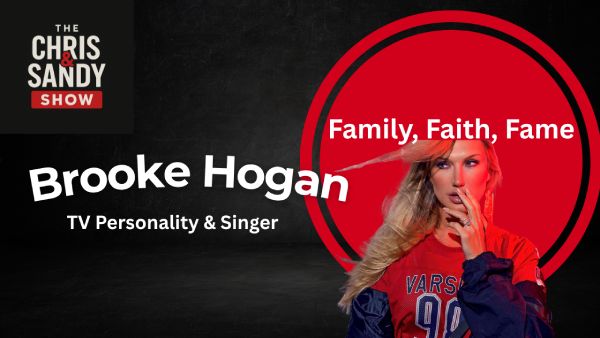
PROFILE SUMMARY
Brooke Hogan is a television personality, recording artist, entrepreneur, interior designer, and public figure whose life journey extends far beyond the fame that first introduced her to audiences around the world.
While many know Brooke from reality television, music, and growing up in one of entertainment's most recognizable families, her story is ultimately one of resilience, reinvention, faith, healing, and personal growth.
Over the years, Brooke has navigated public scrutiny, family challenges, career transitions, grief, entrepreneurship, and motherhood while continually searching for a life rooted in authenticity rather than public expectations.
In her conversation with The Chris & Sandy Show, Brooke reveals a side of herself rarely seen in headlines. She speaks openly about faith, mental health struggles, grief, identity, purpose, healing, and her desire to become a cycle breaker for future generations.
Today, Brooke's story is less about celebrity and more about transformation. She represents the ongoing pursuit of becoming whole, finding peace, building meaningful relationships, and creating a life aligned with faith, family, and purpose.
WHO IS THIS GUEST?
Brooke Hogan's life has unfolded in front of the public eye for much of her adult life, but reducing her story to television appearances or music releases would miss the deeper narrative entirely.
Raised in a household known around the world, Brooke experienced opportunities that most people never encounter. Those opportunities opened doors in music, television, and entertainment, helping launch a career that brought her visibility at a young age.
Yet visibility came with challenges.
Growing up under public scrutiny meant navigating personal experiences while millions of people formed opinions from afar. Family struggles became public conversations. Personal relationships became headlines. Success and hardship often unfolded simultaneously.
Rather than allowing those experiences to define her, Brooke spent years building new chapters beyond entertainment.
She pursued music, entrepreneurship, interior design, business ventures, and creative projects while learning how to separate her personal identity from public perception.
Throughout her journey, faith has remained a consistent foundation. Brooke openly discusses her belief in God, spiritual experiences that shaped her perspective, and the importance of trusting a purpose greater than immediate circumstances.
One of the most significant transformations in her life came through marriage and motherhood. Becoming a wife and mother reshaped her priorities and shifted her understanding of success. Instead of measuring life through recognition or achievement, she increasingly measures it through relationships, purpose, peace, and presence.
Today, Brooke Hogan represents something many people seek but few achieve: the willingness to evolve beyond the expectations placed upon them. Her story is one of learning, healing, rebuilding, and continually choosing growth over bitterness.
That willingness to grow makes her story valuable far beyond entertainment.
WHY THIS CONVERSATION MATTERS
Many celebrity interviews focus on projects.
This conversation focuses on people.
More specifically, it focuses on the person behind the public image.
Throughout the interview, Brooke demonstrates a level of vulnerability that transforms the conversation from a promotional appearance into a meaningful discussion about life itself.
She speaks candidly about family struggles, grief, depression, spiritual experiences, motherhood, healing, resilience, and the challenge of building an identity separate from public expectations.
Those themes matter because they are universal.
Very few people understand celebrity life.
Nearly everyone understands loss.
Nearly everyone understands family struggles.
Nearly everyone wrestles with questions of identity, purpose, faith, healing, and belonging.
Brooke's willingness to discuss those topics openly creates connection.
The interview also serves as a powerful example of what The Chris & Sandy Show does best. Rather than remaining focused on accomplishments, the conversation explores transformation.
Listeners hear about a woman who has experienced public success and personal pain, yet continues choosing hope, growth, faith, and gratitude.
The interview becomes particularly meaningful when Brooke discusses her desire to become a cycle breaker. That single phrase reframes the entire conversation.
This is not a story about surviving fame.
It is a story about using hardship to create something healthier for future generations.
That message makes the interview valuable not only for fans of Brooke Hogan, but for anyone navigating their own healing journey.
In a deeply personal conversation with The Chris & Sandy Show, Brooke Hogan reflects on grief, identity, motherhood, faith, public expectations, and what it means to become a cycle breaker.
More Than a Famous Last Name
For much of her life, Brooke Hogan has been seen through the lens of a name the world already knew.
Television viewers knew her from reality TV. Music fans knew her from her early recording career. Entertainment media knew her as the daughter of one of the most recognizable figures in pop culture.
But on The Chris & Sandy Show, Brooke Hogan offered something far more meaningful than a celebrity update.
She offered a human story.
This was not simply a conversation about television, music, or returning to the spotlight. It was a conversation about identity, family, grief, faith, motherhood, and the long process of becoming whole after years of carrying public and private pain.
Brooke spoke with honesty about the complicated reality of growing up in a famous household, the emotional weight of family struggles being broadcast to the world, and the personal cost of being expected to carry a public image while navigating private wounds.
The result was one of those conversations that reminds listeners why The Chris & Sandy Show exists.
Entertainment may be the doorway.
The human story is the destination.
The Weight Behind the Spotlight
Brooke’s life has included opportunities many people dream about. Television. Music. Public recognition. Industry connections. Access.
But she was quick to explain that opportunity and pain can exist in the same story.
She described her path as a double-edged sword. Her family name opened doors, but the same public association also created pressure, misunderstanding, and emotional complications. She acknowledged the help she received, but she also spoke openly about how family turmoil and public controversy made her road harder.
That honesty matters.
In a culture that often assumes fame equals ease, Brooke’s story reveals a different truth. Public visibility does not protect a person from pain. Sometimes it magnifies it.
She spoke about needing to work harder to prove herself, about surviving financially, waiting tables, building a design business, and finding ways to keep going when the world only saw the famous last name.
One of the most powerful lines from the conversation came when she said:
“I am tired. But I’m still going.”
That sentence carries the weight of the entire interview.
It is not polished celebrity language.
It is human.
It is the voice of someone who has had to keep rebuilding.
Faith In The Valley
One of the most unforgettable moments of the interview came when Chris asked Brooke about a dark moment where God became real to her.
Brooke paused and said she had never told the story publicly before.
She described a season in Los Angeles when her career, finances, and relationships all felt uncertain. She was in a deep depression, questioning who she was and whether everything she had been through had been for nothing.
Then, in an ordinary CVS aisle, while looking at sunless tanner and trying to do something small to feel better, a homeless woman approached her.
The woman did not ask for money.
She simply said she was checking on her.
When Brooke asked for her name, the woman walked away and said:
“Might be God.”
It was the kind of moment that does not fit neatly into an entertainment interview.
It was mysterious.
It was spiritual.
It was deeply personal.
And for Brooke, it became a reminder that God was present even in the valley.
She later shared another spiritual experience involving Jesus, light, and the overwhelming sense that the things we cling to on earth do not matter in the way we think they do when seen through eternity.
Whether a listener hears that through the lens of faith, mystery, or personal testimony, the meaning is clear: Brooke’s faith is not a performance. It is part of how she has survived.
Motherhood And The Life That Matters Most
When asked what feels most like her now, Brooke did not point first to music, television, design, or fame.
She said being a mom.
Motherhood changed the center of her life.
Brooke shared that she and her husband once wondered whether they should have children because life had already been so intense and exhausting. She described the physical and emotional toll of years of work, travel, stress, and survival.
But faith led her to reconsider.
Now, as the mother of twins, she describes motherhood as the best thing in the world.
She said she does not care if anything else works out as long as she can be with her kids.
That statement reveals one of the clearest transformations in the interview.
Brooke Hogan the public figure has become Brooke the mother.
And motherhood has given her a new measure of success.
Not fame.
Not headlines.
Not approval.
Presence.
Peace.
Family.
A home.
A future her children can feel safe inside.
Grief, Gratitude, And Two Things Being True
One of the most moving parts of the conversation came when Brooke described the emotional swings of grief.
She spoke about still having days where the loss and pain connected to her father can overwhelm her. She shared that some days she may feel unable to get out of bed because the grief is so heavy.
And then the next morning, she can look at her children’s faces and say, “God is so good.”
That is the reality of grief.
It does not cancel gratitude.
And gratitude does not erase pain.
Brooke named that truth clearly when she said it is okay to be both.
That may be one of the most important emotional lessons from the interview.
So many people feel pressure to choose one emotional reality. Either they are healed or they are broken. Either they are grateful or they are grieving. Either they are strong or they are struggling.
Brooke’s story says something more honest.
Healing is not the absence of hard days.
Healing is learning how to keep living through them.
Becoming A Cycle Breaker
Near the end of the conversation, Brooke was asked what she hoped people would take away from her story.
Her answer was powerful.
She said she wants to be the cycle breaker.
That phrase reframes the entire interview.
The story is not just about Brooke Hogan returning to music, appearing on television, or building a design career. It is about a woman trying to take what she has lived through and transform it into wisdom, leadership, faith, and healthier patterns for the next generation.
She spoke about wanting to be a leader in faith, vulnerability, growth, and kindness.
She wants people to know it is okay to be vulnerable. It is okay to improve. It is okay to change your mind. It is okay to keep getting better.
That is the lasting value of this conversation.
It is not just about what happened to Brooke.
It is about what she is choosing to do with it.
Fame Is Not The Answer
Brooke offered direct advice to people who want to do what she does.
If the goal is fame, she said, it is the wrong goal.
That line deserves attention because it comes from someone who has actually lived inside fame’s machinery.
She knows what attention can give.
She also knows what it can take.
Her advice was not to chase fame, but to work on yourself, develop a moral code, build a support system, understand your faith, surround yourself with the right people, and find what truly fulfills you.
Then came the quote that may outlive the interview:
“The journey is the whole point.”
That sentence brings the entire conversation together.
Brooke’s life has included success, loss, opportunity, disappointment, grief, faith, motherhood, reinvention, and healing.
And through it all, she has learned not to rush past the present trying to get to some imagined future.
The journey is where the lessons are.
The journey is where God meets us.
The journey is where identity is formed.
The journey is where healing happens.
Why This Interview Matters
This Brooke Hogan interview matters because it offers more than celebrity access.
It offers a portrait of a woman becoming whole.
It shows the cost of public expectations, the complexity of family pain, the grounding power of motherhood, and the role of faith in surviving seasons that feel impossible.
It belongs in The Chris & Sandy Show archive because it reflects the heart of the show’s mission: to go up close and personal, beyond the headline, beyond the résumé, beyond the public image, and into the story that can help someone else.
Brooke Hogan’s story is not finished.
That is part of what makes it meaningful.
She is still healing.
Still building.
Still grieving.
Still creating.
Still mothering.
Still believing.
Still going.
And maybe that is the gift of this conversation.
It reminds us that healing does not always look like having everything figured out.
Sometimes healing sounds like this:
“I am tired. But I’m still going.”
7 Lessons We Learned From Brooke Hogan
Lesson 1: You Can Carry Grief And Gratitude At The Same Time
One of the most powerful moments in this conversation came when Brooke described having days where grief completely overwhelms her. She spoke openly about mornings when the pain surrounding her father feels so heavy that getting out of bed becomes difficult.
Yet she also described waking up the next day, looking at her children, and feeling overwhelmed by gratitude.
Most people spend their lives believing they must choose between those emotions. Either they are hurting or they are healing. Either they are grieving or they are grateful. Either they are broken or they are okay.
Life rarely works that way.
Brooke's honesty reminds us that emotional maturity is often learning how to hold opposing realities at the same time. Healing isn't the absence of grief. Healing is learning how to carry grief without letting it steal your ability to see beauty.
Many people need permission to feel both.
This conversation gives them that permission.
Lesson 2: Fame Cannot Give You An Identity
The world teaches people that recognition creates value.
Get enough followers.
Make enough money.
Become famous enough.
Win enough awards.
Then you'll finally feel secure.
Brooke's story quietly dismantles that illusion.
She has experienced opportunities that many people spend their entire lives chasing, yet some of the deepest parts of this interview centered around discovering who she is outside of public expectations.
When Chris asked who Brooke Hogan is today, her answer wasn't built around television, music, or celebrity.
She talked about being a wife.
A mother.
An artist.
A believer.
A person still healing.
That shift reveals something profound. Identity built on public validation will always feel fragile because public validation can disappear.
Identity rooted in purpose, faith, relationships, and values tends to survive storms much better.
The lesson isn't that success is bad.
The lesson is that success makes a terrible foundation for self-worth.
Lesson 3: The People Around You Shape Your Future
Several times during the interview, Brooke emphasized the importance of surrounding yourself with the right people.
She spoke about her husband with deep admiration. She highlighted lifelong friends who stayed loyal through different seasons of life. She described business partners, mentors, and trusted supporters who helped her continue moving forward.
Success stories often focus on individual achievement.
Real life is rarely that simple.
The people closest to us influence our beliefs, confidence, decisions, emotional health, and growth far more than most people realize.
Brooke's story shows that healing often begins when we stop trying to survive everything alone.
The right people don't just help you accomplish goals.
They help you become the person capable of achieving them.
Choosing your circle may be one of the most important decisions you'll ever make.
Lesson 4: Faith Often Becomes Real In The Valley
The most memorable story from the interview wasn't about television, music, or celebrity.
It was about a CVS aisle.
Brooke described a season where life felt like it was unraveling. Her career wasn't moving. Relationships weren't working. Depression was growing. Questions about purpose were getting louder.
Then came an encounter with a homeless woman who approached her, checked on her, and walked away saying:
"Might be God."
Whether someone interprets that moment spiritually or symbolically, the lesson remains powerful.
Many people expect faith to grow strongest during seasons of success.
More often, faith becomes real during seasons of desperation.
The valley has a way of stripping away distractions.
It forces us to ask deeper questions.
It exposes what truly matters.
And sometimes it becomes the place where we discover we are not nearly as alone as we thought.
Lesson 5: Becoming A Parent Changes The Definition Of Success
Before becoming a mother, Brooke's life revolved around goals, projects, opportunities, and career decisions.
Today, everything is measured differently.
Her definition of success isn't centered around attention.
It's centered around presence.
She repeatedly returned to the idea that being with her children matters more than almost anything else.
That doesn't mean ambition disappears.
It means priorities become clearer.
Many people spend decades chasing achievements while postponing the relationships that matter most.
Parenthood often exposes that mistake.
Brooke's reflections remind us that some of life's greatest accomplishments never appear on résumés, award stages, or social media feeds.
Sometimes success looks like simply being there.
Being present.
Being available.
Being someone your children can depend on.
Lesson 6: Resilience Means Starting Over Without Losing Yourself
Throughout the conversation, Brooke described losing momentum, rebuilding businesses, restarting creative pursuits, navigating personal setbacks, and finding new directions.
At one point she reflected on having opportunities, losing opportunities, and having to begin again.
Many people view resilience as toughness.
Resilience is actually adaptability.
It is the ability to keep moving without allowing disappointment to define your future.
Brooke's willingness to rebuild multiple times demonstrates something important:
Your circumstances may change.
Your identity doesn't have to.
People who survive difficult seasons aren't always the strongest.
Often they're simply the people willing to start again.
And again.
And again.
Until life begins moving forward.
Lesson 7: The Journey Is The Whole Point
If one sentence summarizes the entire interview, it is this:
"The journey is the whole point."
Near the end of the conversation, Brooke encouraged listeners not to rush life.
Not to rush relationships.
Not to rush careers.
Not to rush success.
That advice sounds simple until you realize how much of modern life encourages the exact opposite.
Everyone wants the destination.
Very few people appreciate the process.
Yet when people look back over their lives, they rarely miss the achievement itself.
They miss the moments surrounding it.
The conversations.
The friendships.
The lessons.
The growth.
The people who walked beside them.
Brooke's story reminds us that every season contains something valuable.
Even the difficult seasons.
Especially the difficult seasons.
Because one day those seasons become the very stories that shape who we are.
THE SINGLE BIGGEST LESSON FROM THIS INTERVIEW
If someone remembers only one lesson from this conversation five years from now, it should be this:
You do not have to let your past become your future.
Brooke's story is ultimately about inheritance and choice.
She inherited fame.
She inherited public scrutiny.
She inherited family struggles.
She inherited pain.
But she refuses to pass those things forward unchanged.
Instead, she talks about becoming a cycle breaker.
That phrase transforms the entire interview.
Many people spend years blaming their past.
Others spend years pretending it never happened.
The healthiest path is often acknowledging it, learning from it, healing through it, and creating something better because of it.
Brooke's journey demonstrates that healing isn't about erasing the past.
It's about refusing to let the past make all your future decisions.
That lesson applies to families, marriages, careers, addictions, grief, faith, leadership, and personal growth.
It is one of the strongest lessons anywhere in The Chris & Sandy Show archive.