
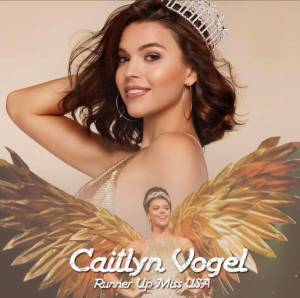
Caitlyn Vogel is a pageant titleholder, model, nursing student, nonprofit founder and disability-inclusion advocate whose public journey has always carried a purpose beyond the stage.
Representing North Dakota, Caitlyn finished as First Runner-Up at both Miss Teen USA and Miss USA 2021, placing her among a very small group of competitors to reach the final two at two major national pageants. Yet her story is defined by more than rankings. Through her organization, Limitless, Caitlyn has worked to create meaningful friendships between people with and without disabilities while helping expand conversations about inclusion, ability and opportunity.
Her advocacy is deeply personal. Inspired in part by her friendship with Bella, who has Down syndrome, Caitlyn has spoken in schools, organized inclusive events and explored ways people with disabilities could hold essential and equitable roles within healthcare.
During her December 11, 2021 appearance on The Chris & Sandy Show, Caitlyn discussed the work hidden behind pageant success, the importance of family belief, the emotional reality of coming close to a dream and the intentional personal growth that helped her become someone who looks for strengths before differences.
Her conversation reveals a young woman using visibility not simply to be seen, but to help others be recognized.
Beyond the Crown: Caitlyn Vogel on Worth, Growth and Building a More Inclusive World
After finishing First Runner-Up at Miss USA 2021, Caitlyn Vogel joined The Chris & Sandy Show for a conversation about the result, the family behind her journey, the person she intentionally chose to become and the mission that mattered more than any crown.
There is a particular kind of silence that exists between two names at the end of a major competition.
By that point, everything has been reduced to one final decision. Months or years of preparation, sacrifice, coaching, service, travel and personal growth appear to rest inside an envelope.
One person will be announced as the winner.
The other will stand only one position away.
Caitlyn Vogel had already experienced that moment once. Representing North Dakota at Miss Teen USA, she reached the final two and finished as First Runner-Up.
Years later, she stood in almost the same place again.
On November 29, 2021, Caitlyn represented North Dakota at Miss USA and once again finished as First Runner-Up. It was an extraordinary achievement, but it also carried an emotional complexity few people ever experience. She had now come within one decision of winning two major national titles.
Less than two weeks later, Caitlyn joined Chris and Sandy Benton for a conversation on The Chris & Sandy Show.
The interview took place on December 11, one day before the Miss Universe competition. Because the reigning Miss USA was preparing to compete internationally, there remained a possibility that Caitlyn could still assume the Miss USA title if the winner advanced to Miss Universe.
That uncertainty could have dominated the conversation.
Instead, it became the background for a much richer story.
The crown mattered. The result mattered. The possibility of what might happen the following evening mattered.
But Caitlyn’s identity did not depend on any of them.
The Dream She Once Kept Quiet
Before Caitlyn became a national pageant competitor, she was a student-athlete growing up in North Dakota.
She participated in three sports during high school, leaving little room for the modeling and pageant interests she quietly carried. She had once written that she wanted to become a model, only to feel ashamed after others treated the dream as unrealistic.
The message was familiar: dreams like that belonged to people from somewhere else.
Not to a girl from a small North Dakota community.
Rather than invite more ridicule, Caitlyn learned to keep the ambition private.
After high school, however, she was no longer participating in organized sports. When a pageant application arrived in the mail, she finally had room to consider the possibility.
The greatest obstacle at first was not talent or confidence. It was the entry fee.
Caitlyn left the application on the counter, uncertain whether she could afford to participate. Her father saw it and offered to pay.
It was a simple decision, but simple decisions can redirect entire lives.
Her father did not know where the application would lead. He did not know his daughter would eventually represent North Dakota twice on national stages, become a working model, complete hundreds of hours of service or stand one place away from Miss USA.
He merely responded to her interest with belief.
Caitlyn later summarized the importance of that moment plainly: her father believed in her before she believed in herself.
She entered the pageant and won.
The dream she had once hidden was suddenly no longer imaginary.
When a Crown Becomes a Responsibility
From the outside, pageantry is easy to misunderstand.
The visible moments are polished: gowns, interviews, photographs, stages, makeup, lights and carefully prepared public appearances. Because beauty is part of the presentation, the work behind the presentation is often dismissed.
Caitlyn challenged that assumption.
She described pageantry as a job—one that did not come with a traditional paycheck but still required professional-level commitment.
There were interviews to prepare for, coaches to meet, appearances to attend, workouts to complete and responsibilities to fulfill. A titleholder was expected to represent an organization, support sponsors, engage with communities and remain aware that her words and behavior could reflect upon more than herself.
Caitlyn was balancing those responsibilities while studying nursing and protecting time for the family relationships that kept her grounded.
She admitted that she did not always reserve enough time for herself.
That observation revealed one of the tensions hidden beneath high achievement. People who are skilled at showing up for responsibilities can become less skilled at noticing their own need for rest.
Caitlyn understood the pressure, but she did not speak about it with resentment. She believed the work had forced her to grow.
That growth was part of the compensation.
Pageantry had opened doors, strengthened her communication skills, expanded her confidence and provided a platform through which she could serve others. She may not have received a salary for every hour, but she believed she was being paid through the impact she was able to make.
That is a different understanding of success.
It does not deny the importance of financial sustainability. It recognizes that some seasons compensate people first through maturity, opportunity, experience and the lives they touch.
Three Questions From Another Young Pageant Voice
The interview included a format The Chris & Sandy Show had not previously used.
Larissa Gaines, a former guest with her own pageant experience, recorded three separate videos and sent them to Chris. Rather than joining the interview live, Larissa appeared through those prerecorded clips. Chris and Sandy played each video during the conversation, and Caitlyn answered the questions one at a time.
The format gave the exchange an unusual sense of connection.
Larissa was not merely a viewer sending a casual question. She understood pageantry from inside the experience. Her questions reflected that familiarity.
First, she asked how Caitlyn’s preparation for Miss USA differed from her Miss Teen USA experience.
Caitlyn explained that both competitions shared similarities, but Miss USA carried a different level of seriousness. Winning could require moving and accepting a much larger set of responsibilities. Her Teen USA experience had prepared her for the long days and mental demands, but the stakes had changed.
Larissa’s second video asked when Caitlyn began pageantry, why she entered and which experience had meant the most.
That question uncovered the application, her father’s support and the dream Caitlyn once felt afraid to share. It also moved the conversation toward the work she loved most: entering schools and helping children become more comfortable discussing disabilities and friendship.
The third video looked beyond the competition itself. Larissa asked what Caitlyn planned to do with the remainder of her reign and what impact she hoped to leave as a two-time national delegate.
That question reached the heart of Caitlyn’s purpose.
Titles eventually expire. Crowns are passed forward. Placements become part of historical records.
Legacy is what remains after all of that.
Seeing Strength Before Difference
Caitlyn’s most meaningful work did not begin with a stage or a sash.
It began with friendship.
She spoke warmly about Bella, her best friend, who has Down syndrome. Their relationship helped reshape the way Caitlyn viewed other people and deepened her commitment to inclusion.
Caitlyn visited schools and began her presentations with a question: Did the students know what Down syndrome or disability meant?
The responses were often uncertain. Children seemed aware that disability existed, but many treated it like an uncomfortable or forbidden subject.
Caitlyn helped make the conversation more human.
She talked about friendship rather than merely delivering definitions. She invited students to imagine getting to know someone whose life or abilities might look different from theirs.
By the end of the presentation, she would ask whether they were willing to make a new friend who might be different from them.
Hands went up.
The excitement mattered because it represented a shift. In the course of an hour, disability had moved from a cautious abstraction to the possibility of a real relationship.
That work became part of Limitless, an organization Caitlyn founded to foster one-on-one friendships between people with and without disabilities.
The Limitless Fashion Show created a setting where participants could be celebrated, empowered and recognized for their beauty and abilities. Yet Caitlyn’s vision did not stop at a yearly event.
She also wanted to explore how people with disabilities could participate meaningfully in healthcare. She discussed working with medical professionals on criteria and opportunities that could allow someone like Bella to hold an essential and equitable role in the healthcare workforce.
The word “equitable” mattered.
Caitlyn was not simply describing the inclusion of someone as a ceremonial gesture. She was imagining real contribution, real responsibility and real belonging.
That is the difference between inviting people into a photograph and building a world in which they have a place.
Becoming Someone Different on Purpose
One of the interview’s most revealing moments began with a question about bullying.
Chris reflected on the difference between bullying in his generation and bullying in the social-media era. The internet allows criticism to follow people home and gives strangers the ability to inflict harm from behind a screen.
Caitlyn could have responded solely as a recipient of judgment.
Instead, she admitted something more difficult.
During high school, she had been on both sides.
She had initially belonged to a social group that was toxic and participated in belittling other people. At some point, she recognized that this was not the woman she wanted to become or the way she wanted to be remembered.
The transformation was not instantaneous.
Caitlyn said it took years of intentionally changing her mindset. Day after day, she practiced seeing people differently until looking for their strengths became more natural than searching for their flaws.
Her honesty gave the conversation unusual depth.
It is easy to construct a personal-growth story in which someone has always been the compassionate one and everyone else has been the problem. Caitlyn resisted that version.
She acknowledged the person she had been without treating that past as a permanent identity.
This is what meaningful accountability can look like.
It does not minimize harm. It also does not demand that a person remain trapped forever inside the worst version of themselves.
Caitlyn recognized the pattern, decided who she wanted to become and practiced new values until they shaped her character.
Her friendship with Bella offered a powerful contrast to the social environment Caitlyn had left behind. Caitlyn noted that their friendship did not depend on talking negatively about other people for entertainment.
It was simply friendship.
That realization helped her understand how empty some earlier relationships had been.
A Human Being Behind Every Screen
Caitlyn’s personal history also shaped how she responded to online criticism.
She understood how easy it was for people to say harmful things when they could hide behind a device. Distance creates the illusion that words have no physical destination.
But every comment arrives somewhere.
There is a person on the other side of the screen.
Caitlyn had experienced dismissive comments about pageantry, including the suggestion that being a “beauty queen” was not a meaningful accomplishment and that there was nothing more substantial behind the title.
The comment hurt, but pageantry had also taught her how to respond without immediately becoming defensive.
She could explain what the work involved. She could express pride in representing North Dakota. She could remain professional.
She also recognized that she did not have to defend every dimension of her identity to a stranger.
That boundary is important.
Maturity does not require responding to every criticism. Sometimes it means clarifying a misunderstanding. Sometimes it means recognizing that another person has already decided not to understand.
The deeper confidence is knowing that someone else’s reduction of your life does not make their description accurate.
The Result Could Choose the Winner, Not Her Worth
When Chris asked Caitlyn how it felt to finish First Runner-Up for the second time on a national stage, she did not hide behind a rehearsed response.
She cried briefly after the result.
She felt as though she were breaking up with the dream.
Watching Miss Universe was difficult because she knew she had come close to being there. Instead of preparing for the international stage, she joked, she was back home shoveling snow.
The image carried both humor and ache.
Caitlyn was able to support the woman who had won while acknowledging her own disappointment. Those responses were not mutually exclusive.
She also understood the nature of competition.
Pageant judging is subjective. A group of judges evaluates a particular group of women during a particular period and chooses the person they believe best fits the title.
The judges had almost selected Caitlyn.
They selected someone else.
Caitlyn’s conclusion was not that she lacked worth. It was that the panel had preferred another contestant by a narrow margin.
“Their subjective opinion doesn’t affect what I believe about myself or what my family believes about me,” she explained.
That may have been the most important sentence in the conversation.
The judges possessed the authority to award the crown.
They did not possess the authority to define the woman.
There is a lesson in that distinction for anyone who has ever been evaluated. Employers choose one applicant. Directors choose one actor. Coaches choose one athlete. Admissions committees accept one student and reject another.
Those outcomes have consequences.
They can redirect lives.
They are not complete measurements of human value.
Caitlyn knew she was worthy before the result. That knowledge allowed her to feel the loss without becoming lost inside it.
When the Crowd Disappeared
Caitlyn’s family remained central throughout the conversation.
She described a moment shortly after Miss USA when she was expected to walk at an after-party as the First Runner-Up. She did not believe her parents would make it into the room because they were elsewhere in the resort with extended family.
Then she saw them.
She was surrounded by hundreds of people. She had just appeared on a national stage. Attendees were watching her walk, pose and embody the polished role expected of a titleholder.
Her instinct was not to preserve the pageant image.
She ran toward her parents.
She kissed her father and held her mother’s hand.
For a moment, the crowd disappeared.
The scene captured the relationship between public success and private belonging. Applause can affirm an accomplishment, but it cannot replace being known by the people who loved someone before the accomplishment existed.
Her father had seen an application on a counter.
Her parents had supported the preparation, pressure and uncertainty.
Now they were standing near the runway after watching their daughter come within one placement of Miss USA.
Caitlyn was grateful the moment had been captured on video, but its importance had nothing to do with the audience.
In her memory, it was only her mother, her father and her.
The Legacy Beyond the Placement
Caitlyn’s title created visibility, but she understood that visibility was temporary.
She planned to continue visiting schools and hoped to travel more extensively throughout North Dakota. She wanted children in communities beyond her immediate area to encounter conversations about inclusion, friendship and disability.
She intended to continue Limitless after her reign ended.
That commitment revealed the difference between a cause attached to a title and a purpose embedded in a life.
If the work disappeared when the crown was passed down, it would have been a campaign.
Caitlyn wanted it to remain part of who she was.
Her nursing education gave that vision another direction. Healthcare can be one of the most consequential places where society either recognizes or underestimates people with disabilities. Caitlyn wanted to participate in a future where ability was evaluated more thoughtfully and opportunity was not automatically withheld because someone did not fit a traditional expectation.
She was building toward a life in which service, healthcare, friendship and public advocacy could reinforce one another.
The pageant stage had amplified her voice.
It did not create the reason she wanted to use it.
7 LESSONS WE LEARNED FROM Caitlyn Vogel
1. Do Not Hand Other People the Authority to Define Your Worth
Caitlyn Vogel stood one decision away from becoming Miss USA. It was also the second time she had finished First Runner-Up on a national pageant stage. That kind of result can easily become emotionally confusing. It is close enough to prove that someone belongs, yet close enough to make them wonder what might have been different.
Caitlyn did not pretend the outcome was painless. She briefly cried. Watching the Miss Universe competition was difficult because she knew how close she had come to potentially standing on that stage herself. She could acknowledge that disappointment without allowing it to become a judgment against her identity.
Her most important realization was that the judges had made a subjective decision. They were authorized to select a winner, but they were not authorized to determine Caitlyn’s value. She knew she was worthy before the result was announced, and her family knew it too.
That distinction applies far beyond pageantry. Employers, directors, coaches, admissions committees and potential partners make choices that affect people’s lives. Those decisions matter, but they are not complete measurements of character, ability or future potential.
A person can respect the process, learn from the result and still refuse to turn someone else’s preference into a permanent verdict about who they are.
2. Real Growth Begins When You Stop Editing Your Past
One of Caitlyn’s most revealing moments came when she admitted that she had experienced both sides of bullying.
She had been around people who treated her poorly, but she had also belonged to a toxic social group that belittled others. That admission would have been easy to avoid. Public figures are often encouraged to present a polished personal history in which they were always compassionate and everyone else caused the problems.
Caitlyn chose honesty instead.
At some point, she recognized that she did not want to be remembered as the woman she was becoming. She began intentionally changing her mindset. The transformation took years. She learned to look for strengths before flaws and began developing healthier relationships that did not depend on tearing down someone else.
That is what makes her story useful. Growth was not simply a statement she made after the fact. It involved recognizing behavior she was no longer proud of, accepting responsibility and repeatedly choosing a different way of seeing people.
People cannot change what they refuse to acknowledge.
At the same time, accountability does not mean living forever under the identity of who someone once was. The purpose of confronting the past is not permanent shame. It is transformation.
Caitlyn’s story demonstrates that a person’s earlier failures can become the starting point of a more compassionate life when they are willing to face them truthfully.
3. One Person’s Belief Can Give a Dream Permission to Begin
Caitlyn had long been interested in modeling and pageantry, but she had learned to keep the dream quiet.
When she was younger, expressing the desire to become a model brought ridicule rather than encouragement. Coming from a small North Dakota community made the dream feel even less realistic. She gradually began to treat it as something she should hide.
Then a pageant application arrived.
Caitlyn did not know whether she could afford the entry fee. Her father saw the application and offered to pay it. There was no guarantee that she would win, no proof that pageantry would become a meaningful part of her life and no way of knowing where that first entry might lead.
Her father supported the attempt anyway.
That decision eventually became connected to state titles, national stages, modeling opportunities, community service and a platform for inclusion. But the importance of his action existed even before any of those outcomes.
He communicated that her interest deserved to be taken seriously.
Parents and mentors do not have to understand every dream before offering support. They also do not have to promise that success is guaranteed. Sometimes the most important response is simply, “Let’s see what happens.”
A person may eventually develop enough confidence to carry their own dream, but many journeys begin because someone else is willing to lend belief before that confidence exists.
4. Visibility Is Most Valuable When It Helps Someone Else Be Seen
Caitlyn’s Miss North Dakota USA title gave her public visibility. She could have used that platform primarily to promote herself, build modeling opportunities or extend her pageant career.
Instead, some of her most meaningful work involved entering schools and helping children understand disability, Down syndrome and friendship.
At the beginning of those presentations, students often seemed hesitant. Disability felt like a subject they were not sure how to discuss. By the end, Caitlyn could ask whether they would be willing to make a friend who might be different from them and watch hands rise with enthusiasm.
The change may have occurred within a single classroom, but its significance was larger. Children who become comfortable with difference are more likely to build inclusive schools, workplaces and communities.
Caitlyn’s work through Limitless extended that mission. The organization fostered one-on-one friendships between people with and without disabilities and created opportunities for participants to be celebrated through a fashion show.
She was also exploring how inclusion might extend into healthcare, where people with disabilities could contribute through essential and equitable roles rather than being treated only as recipients of assistance.
Public attention is temporary. Titles pass to someone else. Social-media interest moves on.
The deeper question is what becomes possible for other people because someone was given a platform.
Caitlyn’s story shows that visibility reaches its highest purpose when it stops being only about the person receiving the attention.
5. Inclusion Is About Relationship and Opportunity, Not Appearance
It is possible to speak about inclusion while still keeping people at a safe emotional distance.
Someone can invite a person with a disability onto a stage, include them in a photograph or offer a symbolic moment of recognition without changing anything about where they are allowed to contribute.
Caitlyn’s perspective went deeper.
Her advocacy grew through friendship, particularly her relationship with Bella, who has Down syndrome. Caitlyn did not describe Bella only as someone she helped. She described her as a best friend whose qualities had influenced the person Caitlyn became.
That difference matters.
When inclusion begins with friendship, people stop being reduced to a cause. They become individuals with humor, strengths, preferences, ambitions and something meaningful to contribute.
Caitlyn’s interest in creating equitable healthcare opportunities demonstrated the same principle. Her vision was not merely for people with disabilities to be present in a hospital or clinic. She wanted them to play essential roles.
True inclusion asks more than whether someone has been invited into the room.
It asks whether they are known, respected, trusted and given a genuine opportunity to participate.
6. Success Has an Invisible Cost
The public sees the stage.
They usually do not see the coaching sessions, travel, workouts, appearances, community responsibilities, preparation, family time surrendered or private pressure that made the stage possible.
Caitlyn described pageantry as a job, even though it was not traditionally paid. A titleholder was expected to remain prepared, represent organizations and sponsors, serve communities, attend appearances and manage the public expectations attached to the crown.
At the same time, Caitlyn was pursuing a nursing degree, modeling and remaining involved with Limitless. She was also trying to protect the family relationships that mattered deeply to her.
Her life was a reminder that achievement is often less glamorous in practice than it appears from a distance.
This lesson applies to artists, athletes, nonprofit leaders, small-business owners and nearly anyone pursuing an ambitious goal. People often admire the finished result while underestimating the repetition and sacrifice required to produce it.
That hidden cost should not discourage people from pursuing meaningful work. It should help them enter with clearer expectations.
Dreams may be beautiful, but they still require calendars, discipline, patience and the willingness to continue working when nobody is applauding.
7. Family Can Keep Success From Distorting Identity
After Miss USA, Caitlyn attended an event where she walked before a large crowd as First Runner-Up. She did not expect her parents to be present because they had been elsewhere in the resort with other family members.
Then she saw them.
The polished public role temporarily disappeared. Caitlyn ran toward her parents, kissed her father and held her mother’s hand.
Hundreds of people were nearby, but in her memory the moment belonged only to the three of them.
That scene reveals something important about healthy ambition. Success can expand someone’s world, but it should not disconnect them from the people who remind them who they were before the recognition arrived.
Caitlyn’s parents had been present before the national stage. Her father had paid the first entry fee. Her family had supported the work, uncertainty and sacrifices that followed.
The crowd knew Caitlyn as a pageant titleholder.
Her parents knew their daughter.
Public recognition can become emotionally dangerous when applause begins to feel more trustworthy than love. Caitlyn’s instinctive response to seeing her parents showed that the attention had not replaced her deepest sense of belonging.
The strongest support systems do more than help people reach success.
They also help them remain themselves after they arrive.
THE SINGLE BIGGEST LESSON FROM THIS INTERVIEW
A Result Can Change Your Direction Without Changing Your Worth
Five years after someone watches this conversation, the most important lesson to remember is that an outcome and an identity are not the same thing.
Caitlyn came exceptionally close to winning Miss USA. The judges’ decision affected what happened next. Had she won, her responsibilities, location, opportunities and public profile could have changed dramatically.
The decision therefore mattered.
But it did not possess unlimited meaning.
It did not prove Caitlyn was less worthy, less prepared or less valuable than she had been before the winner was announced. It revealed only that, during that particular competition, a group of judges selected someone else.
People often allow a single decision to expand far beyond its actual authority.
A rejection becomes “I am not talented.”
A lost opportunity becomes “I will never succeed.”
A relationship ending becomes “I am not lovable.”
A poor performance becomes “I am a failure.”
The event may be real and painful, but the identity attached to it is often a conclusion the person adds afterward.
Caitlyn’s response offered a healthier alternative. Feel the disappointment. Admit that the dream mattered. Learn whatever the experience can teach. Then return to what remains true.
The judges could choose Miss USA.
They could not choose Caitlyn’s worth.
TOP 5 QUOTES
Quote 1
“Their subjective opinion doesn’t affect what I believe about myself or what my family believes about me.”
Quote 2
“That’s not the woman I wanted to be remembered as.”
Quote 3
“I don’t see the flaws in people. I see their strengths first.”
Quote 4
“He believed in me before I believed in myself.”
Quote 5
“Who you are talking to and who you are affecting is a human on the other side of the screen.”
Special Guest Connection: Former Chris & Sandy Show guest Larissa Gaines recorded three exclusive video questions for Caitlyn Vogel, creating one of the first guest-to-guest conversations in the show's archive.


