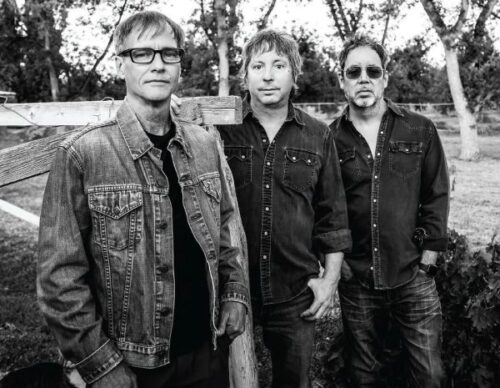
Tony Scalzo is a singer, songwriter, musician, and founding member of the alternative rock band Fastball. As the band's lead vocalist, bassist, and one of its principal songwriters, he helped create enduring hits including The Way and Out of My Head, songs that introduced Fastball to audiences around the world while establishing the group as one of the defining rock bands of the late 1990s. More than three decades into the band's career, Tony continues writing, recording, and touring, balancing a deep respect for music's past with an ongoing curiosity for where creativity can still lead.
During his conversation with The Chris & Sandy Show, Tony moves well beyond stories of chart success. He reflects on the discipline required to sustain a career, the realities of life on the road, the importance of collaboration, and the challenge of remaining grounded after success. His thoughtful perspective on songwriting, identity, humility, artistic purpose, and lifelong learning reveals a musician who continues growing long after achieving the accomplishments many artists spend their careers pursuing. Rather than living on nostalgia, Tony demonstrates that longevity is built through curiosity, professionalism, and an enduring love for music itself.
Beyond “The Way”: Tony Scalzo on Fastball, Creative Curiosity and the Work Behind a Lasting Career
The Fastball singer and songwriter reflects on the discipline behind the breakthrough, the unglamorous truth about touring, the danger of losing yourself in success, and why a lifelong artist must never stop listening.
Millions of people know Tony Scalzo through a melody.
A song begins, recognition arrives almost immediately, and listeners are transported to another season of their lives. For Fastball, songs like “The Way” and “Out of My Head” became more than successful recordings. They became cultural markers—pieces of music capable of reopening memories decades after their release.
Tony understands that power. He has watched familiar songs carry people backward in time, even when he may personally feel ready to hear something different. During his conversation with The Chris & Sandy Show, he recalled complaining about a Journey song playing at the gym because he had heard it countless times. A woman nearby offered an answer he could not dismiss:
It took her back.
That is what music does.
But Tony Scalzo’s story is not only about the songs that take listeners back. It is also about the curiosity that keeps an artist moving forward.
Behind Fastball’s recognizable catalog is a musician who still collects records, searches for forgotten sounds, studies how music fills a room, discovers artists from earlier generations, and becomes nervous around performers he admires. He speaks about success without romanticizing it, discusses touring without pretending it is a permanent vacation, and examines his own motives with the honesty of someone more interested in growing than defending an image.
The result is a portrait of longevity built not merely on talent, but on professionalism, collaboration, humility, curiosity, and the willingness to keep becoming.
Before Fastball, There Was the Decision to Keep Showing Up
Tony’s career did not begin with a record company recognizing an obvious future star.
It developed through bands, day jobs, local shows, relationships, and proximity to people who were taking music seriously.
Growing up in Southern California, Tony was drawn to the complete idea of rock and roll—the performance, the appearance, and especially the chemistry of a band. The Beatles represented the fullest version of that ideal to him: personalities, musicianship, and creativity combining to create something no member would have produced in isolation.
He saw similar forms of identity in the Kinks, the Rolling Stones, and the Beach Boys. Each band possessed its own internal world. The people involved did not simply accompany one visible personality. Their differences helped create the thing itself.
That fascination mattered because Tony did not imagine music merely as solo expression. He wanted to become part of a collective force.
By his early twenties, he had already played with many musicians and spent time onstage, but the possibility of making music his profession became clearer while observing a Southern California band called the Cadillac Tramps. Tony volunteered to help carry their gear. The assignment may not have appeared glamorous, but it placed him near promoters, venue operators, bookers, and people who understood how local music actually functioned.
The experience showed him that a band could do more than rehearse and perform occasionally. It could organize, build relationships, create opportunities, and operate as a business.
At the same time, Southern California’s alternative music scene was helping reshape mainstream rock. Tony was playing in Tender Fury and watching groups such as Jane’s Addiction and the Red Hot Chili Peppers expand what modern rock could become.
Little by little, possibility became conviction.
An opportunity eventually brought him to Texas to perform in another musician’s band. That arrangement did not last, but its failure left Tony in the location where the next part of his life could begin. He met Miles Zuniga and Joey Shuffield, and the musicians began the partnership that became Fastball.
The original opportunity failed.
The relocation did not.
Sometimes a plan accomplishes its purpose without succeeding in the form originally imagined.
Tony had reached Texas expecting one musical future and discovered another.
The Dream Was Music—Not Celebrity
Long before Fastball reached a mass audience, Tony had already decided what would make him happy.
He wanted to tour.
He wanted to make records.
He wanted to perform in theaters for perhaps a thousand people.
He wanted music to become his work.
That vision did not require superstardom. It required enough opportunity to continue doing what he loved.
Then the outcome moved far beyond what he had prepared himself to expect.
When a song becomes a hit, the public sees acceleration. It sees radio play, television exposure, larger stages, press attention, and crowds singing familiar words. The artist experiences those things too, but from inside a machine that suddenly demands motion.
Tony summarized the experience plainly:
“It’s a hit. That means go until it’s not a hit.”
Once success arrives, the next demand follows quickly. Travel. Interviews. Performances. Promotions. Another song. Another record. Another opportunity to extend the moment before the marketplace turns its attention elsewhere.
Fastball suddenly had a record label, management, publishing representation, booking support, and an expanding network of people whose job was to keep the momentum alive.
Tony was in his early thirties, but he admits he was still developing personally. His working life had largely consisted of jobs that supported the real pursuit. He might lay carpet, paint walls, or take whatever work helped him pay bills, attend rehearsal, and buy guitar strings.
There was no gradual executive training program preparing him to manage the emotional and professional consequences of a breakthrough. The band responded with the knowledge and maturity its members possessed.
Yet Fastball had already developed habits that helped prepare them for the opportunity.
Tony did not point first to charisma, industry connections, or even talent when discussing the band’s focus. He remembered that during the formative period, he was not drinking or using drugs. The members were prepared, dependable, and serious enough about schedules that other people mocked them for arriving on time.
If a venue instructed them to arrive at two o’clock, they arrived at two o’clock—even when the sound technician had not.
That detail may not belong in the romantic mythology of rock and roll, but it belongs in the history of a lasting career.
Fastball behaved professionally before the world treated the band like professionals.
The lesson applies far beyond music. People often believe they will become disciplined after receiving a larger opportunity. More often, the habits developed in obscurity determine whether they can carry what arrives in visibility.
The Part of Touring the Audience Never Sees
The concert is the destination.
Touring is everything required to reach it.
Fans see the stage, lights, songs, applause, photographs, merchandise, and perhaps a conversation after the performance. The artists experience those moments, but they also experience the hours surrounding them.
Tony describes those hours without complaint or fantasy.
Touring means deciding where to eat without relying continually on fast food. It means protecting sleep, caring for the body, navigating airports, crossing highways, watching weather systems, waiting in traffic, and adjusting when a flight does not leave.
It means arriving in a city where people recommend a restaurant, invite the band onto a boat, or suggest a local attraction—and having no time to accept.
The band is present for one primary reason: say hello, play the music, and travel to the next place.
For a brief period after “The Way” became a major hit, Fastball traveled with a tour bus and a crew. Across much of the band’s larger career, however, touring has involved a van, the musicians themselves, and perhaps one additional person helping them manage the work.
The road contains moments of genuine joy, but it also contains repetition. Corporate landscapes begin resembling one another. One restaurant chain replaces another. The hotel, airport, highway, backstage room, and venue become the boundaries of a place the musicians never truly get to visit.
Even the word “tour” creates a misleading image. Tourists are shown landmarks. Musicians often see interstates.
Tony recalled becoming stranded in Atlanta when fog disrupted his travel. Situations like that require immediate adaptation: an unexpected hotel, separation from luggage, uncertainty about arrival, or concern that forces outside anyone’s control may prevent the performance.
Then there is the waiting.
Between soundcheck and showtime, musicians may spend hours in backstage areas that are far removed from public ideas of luxury. Tony joked about rooms where touching the walls seemed inadvisable.
Circumstances have improved as Fastball has continued progressing. The band is playing stronger venues and encountering better situations. Yet the unseen work remains.
The performance may last an hour.
The responsibility surrounds the entire day.
A Band Is More Than the Person in Front
Tony’s appreciation for bands is not merely nostalgia for a previous music industry.
It reflects a belief about creation.
Modern entertainment frequently organizes itself around a central personality. The singer becomes the brand. Supporting musicians may change while the public-facing identity remains attached to one individual.
Tony understands individual creativity. He writes songs and develops ideas of his own. But he resists the assumption that one person’s visibility makes everyone else’s contribution secondary.
“I value the input from the people around me,” he explained.
Those people do not always have to be Fastball’s Miles Zuniga or Joey Shuffield. Studio collaborators, musicians, producers, technical professionals, management, booking representatives, publicists, and road support can all add something the original artist did not possess.
Their contributions create dimension.
On the road, one of Fastball’s central team members has been Marcus Morales, a musician Tony met approximately two decades earlier when Marcus’s band opened for Fastball. Tony noticed more than his interest in equipment. Marcus was positive, prepared, and attentive.
Tony initially asked whether he might help with local performances by carrying equipment, tuning guitars, and setting up an amplifier. Miles noticed the difference and asked where Tony had found him.
Trust expanded gradually.
Marcus continued making music and maintained another job, yet he found ways to support Fastball’s touring when schedules allowed. His story illustrates how teams are often formed—not through a dramatic hiring announcement, but through someone repeatedly demonstrating character and competence.
Other members of Fastball’s support system live far from the band. Managers, agents, publicists, and industry professionals work from different cities while helping construct the next stage of the group’s career.
Some are much younger than Tony. He sees that as an advantage rather than an insult.
They understand digital communication, social media, and the current systems required to release music and place a working band on the road. Tony does not need to pretend mastery of every new platform. He needs people who complement what he already knows.
That willingness to receive help may be one of longevity’s least celebrated skills.
A person can spend decades becoming experienced without assuming experience has made collaboration unnecessary.
Unlimited Music, Narrower Listening
Tony has lived through extraordinary changes in how music is purchased, stored, shared, and heard.
Vinyl records gave way to cassettes, compact discs, digital files, downloads, and streaming platforms. Today, a listener can move between eras and genres in seconds.
Tony appreciates that access.
He pays for Spotify and uses it to locate music associated with earlier memories or to explore recordings he may not own physically. YouTube can preserve rare songs transferred from old records long after the original labels, companies, and distribution systems disappeared.
At the same time, he continues collecting vinyl and appreciating the physical experience of sound moving through a room.
His criticism of modern music consumption is not a simplistic rejection of technology. It is a concern about how technology directs attention.
An algorithm studies a choice and assumes it represents a permanent identity. Listen to one style, and similar music begins appearing repeatedly. A single selection becomes a prediction about everything the listener wants next.
The system offers convenience but can quietly narrow discovery.
Tony finds that especially frustrating because the amount of available music is nearly endless. Entire worlds of recordings from the 1950s, 1960s, and 1970s remain unknown to many listeners—not because they lack quality, but because they never became the handful of songs repeated across radio, retail spaces, gyms, and algorithmic playlists.
“We’re able to access more and more, and yet we take in less and less,” he observed.
The answer is not abandoning the familiar.
A familiar song may carry someone back to a first love, a road trip, a family memory, a season of grief, or a period when life felt simpler. Tony recognizes that emotional value even when he has personally heard the song too many times.
But nostalgia should not become a locked room.
He believes discovery remains important as people grow older. New music—and newly discovered old music—can still surprise them. Curiosity does not have to expire when a person’s formative soundtrack is complete.
Tony recently encountered Grace Jones’s earlier work through videos built around high-quality listening experiences. He was struck by the richness of the groove, production, lyrics, and performance.
After a lifetime in music, he was still discovering.
That may be one of the clearest signs that he remains an artist.
Still a Fan After Becoming Part of the Story
Professional success can place a person in rooms once observed from a distance.
It does not necessarily erase awe.
Tony shared a memory of attending a Bob Dylan concert in Nashville during a day away from touring. Because Fastball’s friend Charlie Sexton was performing in Dylan’s band, Tony and his companions gained backstage access and excellent seats.
They did not meet Dylan.
Tony was perfectly comfortable with that.
What affected him was recognizing the musical community surrounding him. Emmylou Harris was nearby. Other admired writers and musicians occupied the same section. Tony experienced the realization that he was no longer observing that world entirely from outside.
He had become part of it.
Yet he still becomes a fan.
Tony admits that meeting admired artists can make him uncomfortable because he wants the human connection so deeply. The desire to say the right thing can create nervousness, disappointment, or the later feeling that he should have handled the moment differently.
That vulnerability appeared again when he encountered bassist Rudy Sarzo at an airport.
Tony recognized him immediately. Sarzo had performed with acts Tony admired and had been part of the 1983 US Festival, where Tony—then nineteen—stood among an enormous crowd through a day featuring major hard-rock and metal performers.
Decades later, Tony approached him almost shaking.
Sarzo treated him warmly.
The encounter mattered because Tony remembered what it feels like when someone you admire makes you feel seen.
Fame did not remove the fan from him.
Perhaps it protected something more important: wonder.
The Harder Question: Why Am I Creating?
Near the end of the conversation, the questions moved beyond the mechanics of a music career and into Tony’s understanding of himself.
What did he hope never to forget?
His answer did not arrive as a polished success slogan.
He admitted he had already forgotten many times.
People absorb their environments. When surrounded by praise, they may begin believing that attention is evidence of superiority. Tony offered a humorous acknowledgment of his own ability, but the larger point was serious: recognition can separate a person from identity.
The work is remembering who you are, where you came from, what you are doing, and what remains important.
That requires quiet.
It requires listening.
Tony described listening to God, listening to other people, and recognizing that God may be present in what those people are trying to say.
The conversation then moved into an even more vulnerable examination of artistic motive.
Tony has asked himself why he writes a song. Is he communicating something honest, or is he attempting to prove how intelligent, insightful, socially conscious, or talented he is?
A creator can disguise ego as service.
A song may appear to carry an important message while privately functioning as evidence the artist hopes will establish his greatness.
Tony has become increasingly willing to confront that possibility in himself.
Once selfish or egotistical motives are recognized, continuing in the same direction becomes difficult—at least when a person is committed to honesty.
His solution has not been to stop creating.
It has been to return to love.
He loves music. Therefore, he can write words that allow the music to exist rather than demanding the song prove his importance. Meaning may be surreal, abstract, associative, or open enough for listeners to discover their own interpretation.
Art does not always need to instruct.
It can invite thought.
Listeners can love a song, hate it, partially understand it, or take something from it the songwriter never planned. If the work causes them to use their imagination, it has accomplished something real.
“Art is like a cue to help people think about things,” Tony said.
The Artist as an Ongoing Work
Tony is proud to be an artist.
But he does not confine artistry to recorded music.
He also sees himself as a work of art—an ongoing creation displayed through how he lives among family and friends.
That work includes mistakes. It includes unexpected decisions, self-care, gratitude, imagination, and the attempt to demonstrate that the world can still be a good place.
At the time of the conversation, Tony described himself as happy, alive, healthy, mentally present, and grateful that aging no longer carries exactly the same limitations earlier generations might have expected.
He continues touring.
He continues writing.
He continues discovering.
He continues asking what motivates him.
And he still wants Fastball’s reach, opportunities, and financial stability to grow. He did not hide the practical side of that desire. Music is his livelihood. He would like to pay off his home and make the most of the working years in front of him.
There is no contradiction between artistic purpose and practical responsibility.
His final advice to aspiring musicians brings the entire conversation together:
Treat it like a business.
Not because money should become the only measure, but because every action affects the future. Small decisions matter. Reliability matters. Honesty matters. Focus matters. Health matters. Learning how to connect with an audience matters.
Talent may open a door.
Professionalism helps someone remain in the room.
Curiosity keeps the work alive after the room becomes familiar.
Humility helps the artist remember that the room was never theirs alone.
SEVEN LESSONS WE LEARNED FROM TONY
Lesson 1: Prepare for the Opportunity Before It Arrives
Fastball’s success may be remembered through hit songs, large audiences, record sales, and national recognition, but Tony Scalzo points toward something far less glamorous when explaining what helped the band move forward: they behaved professionally.
During the band’s formative years, Tony and his bandmates were focused, dependable, and punctual. Other people sometimes mocked them because they took schedules so seriously. When told to arrive at a venue at two o’clock, they arrived at two—even when the sound technician had not yet shown up.
That habit may seem insignificant compared with talent or creativity, but it represents a larger principle. The members of Fastball treated music like a real career before the industry provided proof that it could become one.
Many people assume they will become more disciplined when a larger opportunity appears. They imagine they will become organized after receiving more money, more recognition, a better position, or a bigger audience. Tony’s story suggests the reverse. The habits developed before the breakthrough often determine whether someone is prepared to carry what arrives afterward.
Opportunity magnifies existing behavior. It does not automatically create character.
Preparation is not merely learning how to perform when the spotlight turns on. It is becoming reliable when very few people are watching.
Lesson 2: A Failed Plan Can Still Bring You Where You Need to Be
Tony did not originally move to Texas to form Fastball.
He relocated because of an opportunity to perform in another musician’s band. That arrangement did not work out. Judged only by its intended purpose, the move could have been considered a failure.
But Tony was still in Texas.
That placed him in the environment where he met Miles Zuniga and Joey Shuffield. Together, they formed the musical partnership that eventually became Fastball. The opportunity that failed delivered Tony to the location where another opportunity could begin.
Life often makes more sense in reverse than it does while events are unfolding. A closed door may feel like wasted effort because we evaluate it according to the outcome we expected. We rarely know whether the greater purpose was the job, relationship, project, or destination itself—or whether it was the people, knowledge, connections, and direction discovered along the way.
A plan does not have to succeed exactly as imagined to become meaningful.
Sometimes the purpose of one opportunity is to carry us into position for another.
Lesson 3: Success Does Not Eliminate the Need to Know Who You Are
When Chris asked what Tony hoped never to forget, Tony did not pretend he had always remained perfectly grounded.
“I’ve forgotten it so many times,” he admitted.
People are influenced by their environments. When surrounded by praise, attention, and voices repeatedly affirming their greatness, they can slowly begin confusing admiration with identity. The danger is rarely a sudden decision to become arrogant. It is the gradual acceptance of an environment’s version of who they are.
Tony’s answer was to remember who he is, where he came from, what he is doing, and what remains important. That requires slowing down, becoming quiet, and listening.
His honesty makes the lesson more powerful. Remaining grounded is not something a person accomplishes once. It is a repeated return.
Success can increase the number of people speaking into a person’s life while decreasing the number of voices they truly hear. Tony’s instruction to “do more listening” is therefore not passive. It is a discipline that protects identity from applause, ego, pressure, and isolation.
The higher someone rises, the more intentionally they may need to return to what was true before everyone began telling them who to become.
Lesson 4: Collaboration Creates What Individual Talent Cannot
Tony has always been drawn to the idea of a band.
He admires the way individual personalities, creative instincts, and musical abilities combine to make one recognizable sound. The Beatles, the Kinks, the Rolling Stones, and the Beach Boys represented different forms of that chemistry. Their identities were shaped not merely by one visible person but by what happened when distinct contributors worked together.
Modern culture often celebrates individual visibility. One person becomes the star, the brand, or the center of the story. Tony sees a danger in that structure because it can encourage self-centeredness and diminish the value of everyone surrounding the most recognizable figure.
Tony is an individual songwriter and musician, but he does not treat independence as proof that other people are unnecessary. He values the input of Miles, Joey, studio musicians, producers, road support, managers, publicists, agents, and younger professionals who understand systems he does not.
Collaboration does not weaken personal vision. The right collaboration gives that vision dimensions it did not previously possess.
This lesson applies to bands, marriages, businesses, churches, families, and creative partnerships. Strong leaders do not prove their importance by becoming the only necessary person. They create space where different people can contribute something no individual could have produced alone.
Lesson 5: Curiosity Is One of the Keys to Remaining Alive Creatively
Tony loves the music that shaped him, but he does not believe discovery should end when a person’s formative years are over.
He can return to familiar recordings through vinyl, streaming services, and YouTube. He understands why listeners want the music that carries them back to another time. Yet he also sees how algorithms can repeatedly push people toward what they already know.
That creates one of modern culture’s great contradictions: people have more access than ever, but they may explore less.
Tony resists that pattern by deliberately seeking unfamiliar music. Some of it is new. Some is old music he never previously encountered. His discovery of Grace Jones’s earlier work reminded him that extraordinary art can exist for decades outside a person’s awareness.
Curiosity keeps identity from becoming frozen around the tastes, assumptions, and experiences of one period of life. It asks people to remain teachable even when they are experienced.
A person does not outgrow wonder unless they stop making room for it.
Tony’s willingness to discover keeps him connected to the reason he began making music in the first place. He is not only a professional analyzing a product. He remains a listener capable of surprise.
Lesson 6: Examine the Motive Beneath the Mission
One of the conversation’s most revealing moments came when Tony discussed why he writes songs.
He has been examining whether some of his supposedly meaningful creative motives were actually attempts to prove that he was intelligent, socially aware, important, or talented. A song may appear to carry a positive message while privately serving the artist’s desire to demonstrate greatness.
That realization is uncomfortable because ego frequently disguises itself as purpose.
People can say they are helping others while needing to be recognized as helpers. They can speak about leadership while craving authority. They can promote a cause while quietly building a personal image. They can create inspirational work while needing the audience to confirm their importance.
Tony does not resolve this tension by claiming completely pure motives. He responds by stepping back and asking what he honestly wants to say.
His answer brings him back to love. He loves music. Therefore, he can write lyrics that serve the song rather than forcing every composition to prove his intelligence or importance.
The lesson is not that people must distrust every meaningful ambition. It is that they should examine what sits beneath it.
Purpose becomes healthier when it is separated from the constant need to prove oneself.
Lesson 7: Take Care of the Person Who Must Carry the Dream
Near the end of the interview, Tony offered practical advice to anyone hoping to build a career like his.
Treat the work responsibly. Stay focused. Be honest. Learn how to entertain. Pay attention to details. Treat people well. Document the journey. And take care of yourself.
Tony spoke directly about temptations associated with the stereotypical rock-and-roll lifestyle. His message was not subtle: people do not need drugs, excessive alcohol, sexual conquest, or destructive appetites to experience a meaningful life or career.
Those impulses may feel urgent, but Tony called them unreal appetites. They promise fulfillment while often damaging the health, relationships, judgment, and stability required to sustain the opportunity someone worked to receive.
A dream must be carried by a human body, mind, and character.
Neglecting that person in pursuit of the dream eventually threatens both.
Tony’s touring advice follows the same principle. Sleep matters. Food matters. Moderation matters. Health becomes especially important as a career continues across decades.
People often protect their equipment, businesses, platforms, intellectual property, and financial investments more carefully than they protect themselves. Yet every mission depends on the condition of the person responsible for carrying it.
Taking care of yourself is not selfish when it allows you to remain present for your work, family, relationships, and purpose.
Tony’s final message is both practical and hopeful: focus, care for yourself, and enjoy being alive.
THE SINGLE BIGGEST LESSON FROM THIS INTERVIEW
Long-Term Success Requires Repeatedly Returning to What Is Real
If someone remembered only one lesson from Tony Scalzo’s conversation five years from now, it should be this:
The greatest challenge is not simply reaching success. It is remaining connected to reality after success changes the environment around you.
Tony’s career contains many of the achievements aspiring musicians imagine. He became part of a successful band, wrote and recorded recognizable music, toured extensively, worked with major industry professionals, and gained entry into a musical world he once observed as a fan.
Yet none of those achievements eliminated the need for discipline, listening, self-examination, teamwork, health, humility, or personal growth.
Success increased the importance of those qualities.
Tony’s most important reflections involve returning. Returning to the reason he creates. Returning to the people around him. Returning to curiosity. Returning to responsible habits. Returning to his identity when the environment begins telling him a more flattering version of himself.
That repeated return is what makes longevity possible.
People frequently think perseverance means refusing to stop moving. Tony’s story shows that perseverance can also mean pausing long enough to ask whether the movement is still honest.
It means listening when ego wants to speak.
It means receiving help when experience says you should already know everything.
It means remaining a fan when your own achievements could make wonder seem childish.
It means remembering that the career is part of your life, but it is not the complete definition of who you are.
TOP FIVE QUOTES
1.
"Remember who you are, where you came from, and what you're doing."
2.
"Do more listening."
3.
"God's in other people too, so listen to what they have to say."
4.
"Everybody used to make fun of us because we were always on time."
5.
"Treat it like a business."