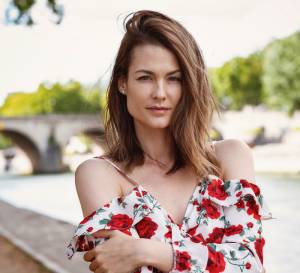
Lauriane Gilliéron is a Swiss actress, media personality, former Miss Switzerland and animal advocate whose career has crossed international pageantry, American television, European entertainment and film. After placing second runner-up at Miss Universe 2006, she moved to Los Angeles to pursue a dream she had carried privately for years: becoming an actress. Her screen work has included appearances on CSI: Crime Scene Investigation, Castle, Psych, Days of Our Lives and The Bold and the Beautiful, as well as the action film Love on the Rock.
Her conversation with The Chris & Sandy Show reaches well beyond titles and television credits. Lauriane speaks candidly about arriving in America without strong English-language skills, facing constant rejection, discovering why passion must come before fame and eventually recognizing when a once-beloved season of life had reached its end. She also reflects on animals, grief, family, gratitude and the importance of treating people with kindness—whether they are standing in front of a camera or working quietly behind it.
Beyond the Crown: Lauriane Gilliéron on Courage, Rejection and Following the Life That Called Her
The former Miss Switzerland and Miss Universe second runner-up shares how an unexpected pageant entry led her from law school to Los Angeles, acting, animal advocacy and a deeper understanding of what truly sustains a dream.
Some careers begin with a carefully constructed plan.
Lauriane Gilliéron’s began with a newspaper advertisement she noticed during a lunch break.
She was studying law in Switzerland, not because she had spent her childhood dreaming of becoming an attorney, but because she had finished school, her best friend was attending law school and she had not yet discovered what direction she truly wanted her life to take.
Hidden beneath that uncertainty was another dream.
Lauriane had always wanted to become an actress. She had simply never trusted herself enough to pursue it.
Then she saw an advertisement inviting eligible young women to enter the Miss Switzerland competition. She had never grown up watching pageants or imagining herself wearing a national crown. Still, something about the opportunity made her wonder whether it could become a small opening into the entertainment world she secretly wanted to enter.
She sent in a photograph.
That single decision changed the direction of her life.
Lauriane won Miss Switzerland in 2005 and traveled to Los Angeles to represent her country at Miss Universe 2006, where she finished as second runner-up. The title brought attention, opportunities and public recognition, but its greatest impact may have been more personal.
It showed her that an unexpected door could lead toward the life she had been afraid to claim.
The Opportunity That Did Not Look Like the Dream
Lauriane’s story is a reminder that purpose does not always arrive in its final form.
She did not see the Miss Switzerland advertisement and immediately understand how every chapter of her future would unfold. She saw an opportunity that might create a small opening toward acting.
It became far more than a small opening.
Winning Miss Switzerland introduced her to an entirely different world. She became one of the most recognizable public figures in a country that, as she explained during her conversation with The Chris & Sandy Show, does not have the same large celebrity culture found in places such as Los Angeles.
That sudden attention came with pressure.
Lauriane was only 21 years old when she was thrown into the public spotlight. She had not been trained to handle reporters looking for controversial statements, embarrassing moments or material that could be turned into a headline. She had to learn quickly how to protect herself without losing her openness.
She was fortunate, she said, to have her head on her shoulders. But she also understood how damaging that level of attention can become for young people who have not yet developed the maturity or support needed to navigate it.
Public recognition creates a complicated bargain. Performers naturally want their work to be seen. They want opportunities, credibility and a connection with audiences. Yet the same attention that validates a career can also invite intrusion and judgment.
“You want the recognition,” Lauriane explained, “but you don’t want the annoying part that goes with it.”
Age and experience eventually gave her a stronger ability to separate those things. If greater success came later in life, she believed she would now be better prepared to manage it.
The crown may have introduced Lauriane to the world, but it did not answer the deeper question of who she wanted to become.
That answer began to take shape in Los Angeles.
Where Everything Felt Possible
Lauriane had traveled to Los Angeles for the Miss Universe pageant, but she fell in love with something larger than the competition.
She was drawn to the city’s energy.
Los Angeles was not necessarily beautiful to her in a traditional sense, but it carried a feeling she could not ignore. She felt that possibilities were everywhere. She sensed that she belonged there and that the city was where she needed to spend her twenties.
So she packed her bags and moved.
There was no guarantee that acting would work. Lauriane did not even know for certain whether she was capable of doing it professionally. Her English was limited, the immigration process was complicated and she faced an industry filled with people who had already been training, auditioning and building relationships for years.
She arrived at approximately 22 years old with far more courage than certainty.
“I was young,” she recalled. “I was 22, and I was just fearless.”
Her approach was simple: try acting, discover whether she loved it and return home if she did not.
That willingness to experiment changed everything.
Once she began acting, she found a place for emotions she had not always known how to express in ordinary life. Anger, vulnerability, fear and intensity could be explored through a character. Acting became more than a career goal; it became a creative language.
“I started acting, and I loved it,” she said.
The work gave her emotions somewhere to go.
She trained, worked through the legal process required to remain and work in the United States and eventually secured a green card. Only then could she begin pursuing roles with a stronger professional foundation.
The process was far removed from the popular fantasy of being discovered in a coffee shop and becoming an overnight star.
It required years of preparation, paperwork, auditions and rejection.
Even small appearances—sometimes only one or two lines on a television series—could demand extensive preparation and competition. Lauriane would eventually appear on programs including CSI: Crime Scene Investigation, Castle, Psych, Days of Our Lives and The Bold and the Beautiful. Those credits may look impressive when placed together, but each represented only the visible result of a much larger invisible process.
Audiences see the finished scene.
They rarely see the waiting, uncertainty or emotional energy required to reach it.
The Reality Behind the Acting Dream
When people in Switzerland ask Lauriane how they can become actors, she offers advice that is honest enough to sound discouraging until its deeper purpose becomes clear.
“If you do it because you love it, then do it,” she said. “But if you do it for the money, for the fame, please do something else.”
She is not telling people to abandon meaningful dreams.
She is asking them to understand what must sustain those dreams when recognition does not arrive.
Acting can involve rejection most of the time. A performer may train, prepare and emotionally invest in a role only to be told no. They may receive no explanation. They may be competing against hundreds of others. They may lose an opportunity for reasons having little to do with talent.
If the only goal is fame, the process quickly becomes unbearable.
Lauriane described such a career as potentially unhealthy when passion is absent. There is little value in choosing a life in which doors repeatedly close unless something about the work itself remains meaningful.
That lesson extends far beyond acting.
People often become attracted to the visible outcome of a profession while remaining unaware of its daily reality. They want the finished book but not the lonely writing. They want the business success but not the financial uncertainty. They want the performance but not the rehearsals. They want recognition without the years of obscurity that may precede it.
Passion does not remove difficulty.
It gives difficulty a reason.
Lauriane’s career was not sustained because every audition produced a role. It was sustained because the work itself gave her something that success alone could not provide.
That distinction matters in a culture that increasingly encourages people to build public identities before they have developed private foundations.
Visibility is not the same as purpose.
Fame is not strong enough to carry someone through a life built around rejection.
When a Beloved Chapter Becomes Lonely
For approximately a decade, Los Angeles felt like home.
Lauriane created a life there. Her family visited. She built friendships, formed routines and woke up with the feeling that everything was possible.
Then the experience began to change.
The final years became more difficult. Work was less consistent, and loneliness began to replace some of the excitement that had once defined the city.
There is a particular kind of grief in realizing that a place connected to one’s dreams no longer feels the way it once did.
Leaving can appear like failure, especially when the place represents ambition, independence or a former version of oneself. People may remain inside expired seasons because they fear that moving forward will invalidate everything they sacrificed to get there.
Lauriane eventually recognized a truth that appears simple but often requires courage to accept:
“Everything has a cycle.”
A chapter can be meaningful without being permanent.
Los Angeles had given her growth, adventure, training, friendships and professional opportunities. Returning to Europe did not erase those things. It allowed her to respond honestly to the person she had become.
She briefly lived in Paris, a city she found beautiful but overwhelming, and eventually felt a strong pull toward Switzerland and her family.
She could not fully explain the urgency. She simply sensed that she needed to return to her roots.
Several months later, the COVID-19 pandemic began.
Borders closed, productions stopped and families around the world were separated by uncertainty. Lauriane felt grateful that she had listened to the pull that brought her home before the crisis began.
She was close to the people she loved.
That timing reinforced something her career had already taught her: not every important decision can be justified in advance. Sometimes people sense that a season is changing before they can explain why.
Peace in a World That Had Stopped
Lauriane spoke carefully about the pandemic.
She understood that people became ill, lost loved ones, lost work and experienced deep suffering. She did not minimize that reality.
At the same time, she admitted that part of her felt relieved when the world stopped.
The pace of life had become exhausting. The shutdown gave her permission to slow down, read, watch films, reconnect with animals and spend hours walking through nature.
She sometimes left with little more than her phone and walked for three hours before returning home.
Nature gave her a place to breathe.
She described the period as a kind of reset—a painful global event that also forced many people to confront how they had been living. For Lauriane, it created room to return to herself.
“I found some peace in it,” she said.
That peace did not require pretending the larger crisis was good. Human beings can acknowledge suffering while also recognizing the personal truths difficult seasons reveal.
For some, the shutdown exposed loneliness or instability. For others, it revealed how much of their identity depended on constant activity. Many discovered that the life they had been rushing to maintain was no longer the life they wanted.
Lauriane had already begun that reevaluation by returning to Switzerland.
The pause allowed it to deepen.
A Compassion That Began in Childhood
Lauriane’s connection to animals was not a cause she discovered after becoming famous.
It began on her grandparents’ farm.
She spent weekends and vacations surrounded by rabbits, chickens, donkeys and ponies. Animals were part of her childhood world, not distant creatures separated from everyday life.
At seven years old, she experienced what she described as an epiphany. She realized that the animals she viewed as companions were connected to the food people ate.
She became a vegetarian even though no one around her was following the same lifestyle.
Her parents could have dismissed the decision as a childhood phase. Instead, they allowed her to remain connected to her sensitivity and make choices that reflected it.
That support mattered.
Children are often taught to ignore their strongest instincts when those instincts inconvenience adults or challenge established routines. Lauriane’s parents gave her space to listen to her compassion before she could fully explain it.
Later, when Miss Switzerland gave her a public platform, she used it to support animal causes and rescue organizations.
The advocacy grew from identity rather than image.
Her love for animals also shaped one of the most emotional periods discussed in the interview.
Years later, in the middle of a pandemic and an uncertain professional season, Lauriane lost the cat she considered her best friend of ten years.
She was grieving deeply when an unexpected email arrived.
Grief, an Old Manager and Three Days to Malta
The email came from a former manager Lauriane had not spoken with in roughly a decade.
His friends were producing a film in Malta and searching for an actress who could work internationally. He sent her the audition material and asked whether she wanted to submit a self-tape.
Under different circumstances, Lauriane might have approached the opportunity with pressure and expectation.
But grief had changed her emotional position.
She was in bed, mourning her cat and moving through a period when very little seemed to matter. She called her sister and asked for help recording the audition.
They needed someone who could read the other lines in English. The scene required Lauriane to pretend she was holding a gun. The situation felt improvised and slightly chaotic.
They also had fun.
Because Lauriane was not trying to control the outcome, she felt free. That freedom came through in the performance.
She submitted the tape.
The production invited her to a Zoom callback—an unfamiliar audition format at the time. She met the casting director, producer and director remotely and was eventually asked to read for the lead role.
She got the part.
Three days later, she was leaving for Malta.
There were COVID tests, packing arrangements and plans for someone to care for the pet she still had at home. The preparation was frantic, but the experience became one of the great surprises of her career.
The cast and crew formed what Lauriane described as a bubble. The outside world was largely shut down, but inside the production, a group of people who had never met became a close team while filming Love on the Rock.
She said it felt as though the stars had aligned.
The timing did not make her grief disappear. Life rarely replaces one emotion cleanly with another. The opportunity simply gave movement to a season that had become emotionally still.
The story illustrates something more honest than the idea that every loss leads to a reward.
Sometimes pain and possibility occupy the same room.
A person can be grieving and still answer an email.
They can feel lost and still record the audition.
They can lack enthusiasm for the future and still take one small step that allows the future to find them.
No One Makes the Movie Alone
Lauriane’s memories of filmmaking reveal more than excitement about travel or performance.
They reveal how she understands the people around her.
Actors often become the most visible part of a production. They stand in front of the camera, appear on posters and receive interview requests. On set, numerous departments focus their attention on preparing and supporting them.
That attention can distort a person’s sense of importance.
Lauriane consciously resists that distortion.
Hair, makeup, wardrobe, lighting, sound, technicians, producers, directors and crew members all contribute to what the audience eventually sees. The fact that the actor is visible does not mean the actor created the result alone.
“Without everyone on that set, nothing would be possible,” she explained.
She described herself as grateful and kind to the people around her because she understands that she is nothing without the team.
This is one of the conversation’s most valuable leadership lessons.
Every industry has visible people and invisible contributors. A company leader may receive credit for work completed by an entire staff. A speaker stands on a stage built by organizers, technicians and volunteers. A successful event may become associated with one name despite depending on dozens of people.
Healthy leadership remembers the names behind the outcome.
It treats people well not because they may become useful later, but because their work and humanity already have value.
Why Kindness Still Matters
Lauriane had also begun co-hosting a morning radio program in Switzerland, where she interviewed people from different professions, backgrounds and points of view.
She did not agree with every guest.
She did believe they deserved respect.
Her approach was to remain neutral enough to understand where someone was coming from rather than inviting them into a conversation only to fight with them.
That philosophy shaped one of the most meaningful exchanges in her appearance on The Chris & Sandy Show.
Lauriane spoke about the damage created when media platforms invite guests on only to provoke, embarrass or diminish them. She questioned why anyone would ask a person to participate in an interview if the real goal was to break them down.
“Why would you have me on your show if it’s to break me down?” she asked.
The question reaches beyond celebrity interviews.
Much of modern communication has become performative conflict. People do not listen to understand; they listen for material they can attack. Disagreement becomes an excuse to deny another person’s humanity. Outrage receives more attention than curiosity.
Lauriane believes people need something different.
They need kindness, positive energy and conversations that allow them to understand one another.
That does not mean refusing to ask honest questions. It means refusing to confuse cruelty with courage.
The Chris & Sandy Show was created around a similar principle. Guests may arrive because they are promoting a film, television series, album or project, but promotion is only the doorway. The real goal is to understand the person behind the accomplishment.
Lauriane recognized that intention.
She appreciated that young performers and established celebrities could enter the conversation without fearing that the hosts were waiting to expose or humiliate them.
Trust allows a guest to reveal something deeper than a rehearsed answer.
It allows an interview to become a human exchange.
The Life Beyond the Title
Lauriane Gilliéron’s public story contains the kind of achievements that fit easily into an introduction.
Miss Switzerland.
Second runner-up at Miss Universe.
Actress.
Television appearances.
International film.
But the deeper value of her story lives between those accomplishments.
It lives in the law student who noticed an advertisement and wondered whether an unfamiliar opportunity might lead toward a private dream.
It lives in the young woman who moved to another country before she knew whether she could build a career there.
It lives in the actress who learned that passion must be stronger than rejection.
It lives in the public figure who became more interested in humane conversation than sensational attention.
It lives in the animal lover whose compassion began on a farm long before anyone knew her name.
It lives in the grieving woman who answered an unexpected email, recorded a self-tape with her sister and found herself traveling to Malta three days after receiving a role.
Lauriane’s journey does not suggest that every uncertain decision will lead to a crown, a television career or an international film.
It offers a quieter and more useful lesson.
You do not always need to know what an opportunity will become before giving yourself permission to explore it.
Sometimes the next chapter arrives disguised as something unrelated to the dream.
Sometimes leaving is not failure but recognition that a cycle is complete.
Sometimes the work must matter more than the applause.
And sometimes, during a season when very little seems possible, the most important thing a person can do is answer the email, call their sister and say:
“Let me just try.”
Key Takeaways From the Conversation
Lauriane’s journey shows that the most important opportunities do not always resemble the destination a person originally imagined. Entering Miss Switzerland was not her ultimate dream, but it became the bridge that helped her trust her desire to act.
Her story also offers a necessary reality check about creative careers. Talent and ambition matter, but they are not enough to withstand repeated rejection. The work itself must carry meaning.
Success, Lauriane reminds us, is never created alone. Visibility should deepen gratitude rather than inflate self-importance.
Her return to Switzerland demonstrates that leaving a beloved chapter does not erase its significance. Every season has a cycle, and recognizing an ending can be an act of growth.
Finally, the interview reinforces the power of kindness. Whether speaking with a political guest, working with a production crew or interviewing a public figure, respect creates room for a deeper truth than hostility ever could.
7 LESSONS WE LEARNED FROM LAURIANE GILLIERON
1. The Opportunity That Changes Your Life May Not Look Like Your Dream
Lauriane Gilliéron did not grow up dreaming of becoming Miss Switzerland. She was studying law, uncertain about her long-term direction and privately carrying a desire to become an actress that she had not yet trusted herself to pursue.
Then she noticed an advertisement during a lunch break.
Entering a pageant may not have looked like the obvious route toward acting, but Lauriane recognized that it could create an opening. She sent a photograph, entered the competition and won. That victory eventually took her to Miss Universe in Los Angeles, where she felt drawn toward the city and the possibilities it seemed to represent.
People often reject opportunities because they do not resemble the final destination they have imagined. They expect the path toward a dream to arrive clearly labeled. In reality, life frequently moves through bridges, detours and experiences whose importance becomes visible only later.
The lesson is not to say yes to everything. It is to remain open enough to recognize when an unexpected opportunity might develop a skill, create a relationship or awaken a part of you that has remained hidden. Lauriane’s pageant journey did not replace her dream. It helped her believe the dream might be possible.
2. You Do Not Need Complete Confidence Before You Begin
When Lauriane moved to Los Angeles, she did not arrive with certainty that she would succeed. She was not even fully sure that she could act professionally or that she would enjoy the work once she began doing it.
Her English was limited. She faced immigration requirements, needed training and was entering one of the most competitive entertainment industries in the world.
She went anyway.
“I was young. I was 22, and I was just fearless,” she recalled.
There is a difference between confidence and courage. Confidence says you believe you will succeed. Courage says you are willing to proceed without knowing whether you will.
Many people wait for confidence before beginning something meaningful. They assume fear or uncertainty means they are not ready. Yet confidence often develops only after experience. Lauriane discovered her love for acting by acting. She found proof that she could build a life in Los Angeles by attempting to build one.
Sometimes the most honest commitment is not, “I know this will work.”
It is simply, “Let me just try.”
3. Passion Must Be Stronger Than the Reward
Lauriane offered one of the interview’s most direct warnings when discussing the reality of acting:
“If you do it because you love it, then do it. But if you do it for the money, for the fame, please do something else.”
Her words come from experiencing both sides of public life. She knows what it feels like to win a national pageant, represent her country and receive widespread attention. She also knows what it feels like to prepare extensively for small roles, confront repeated rejection and live through seasons when work becomes less consistent.
Public success can make a career appear easier than it was. People see the credit on a television series but not the auditions that led nowhere. They see the photograph or premiere but not the months of waiting. They see recognition but not the private doubts required to endure long enough to receive it.
Passion does not guarantee success, nor does it remove financial pressure. It gives a person a reason to continue when the visible reward is absent.
This lesson applies to any demanding pursuit. A business cannot be sustained entirely by the fantasy of becoming wealthy. A book cannot be written solely for applause. A ministry, nonprofit or creative project cannot remain healthy when the person leading it is dependent on recognition.
The outcome may inspire the beginning, but love for the work must sustain the middle.
4. Leaving a Chapter Does Not Mean It Was a Failure
Los Angeles gave Lauriane some of the most formative years of her life. She built a home, pursued acting, welcomed visits from her family and woke up feeling that everything was possible.
Eventually, however, the experience changed.
The final years became lonelier. Work was less consistent, and the city that had once represented possibility no longer felt like the place where she needed to remain. She returned to Europe and ultimately to Switzerland.
“Everything has a cycle,” she said.
This is a difficult truth because people often measure the success of a decision by how long it lasts. They assume that leaving a city, career, relationship, business model or former dream means the original choice must have been wrong.
But some seasons accomplish exactly what they were meant to accomplish and then end.
A chapter can develop you without becoming your permanent identity. Los Angeles gave Lauriane training, experience, relationships and the courage to build an international life. Returning home did not cancel those years. It reflected the wisdom to recognize that she had changed.
There are times when perseverance means staying.
There are also times when growth means admitting that the life which once fit you no longer does.
5. Pain and Possibility Can Exist at the Same Time
Lauriane had recently lost the cat she described as her best friend of ten years when an unexpected acting opportunity arrived.
She was grieving and emotionally withdrawn when a former manager contacted her after years of silence. A film was preparing to shoot in Malta, and the production needed an actress who could work internationally.
Lauriane could have ignored the email. Instead, she called her sister and recorded the self-tape.
The audition did not erase her grief. The role did not replace the animal she had lost. Life rarely offers such simple exchanges. Instead, the story shows that pain and possibility can exist at the same time.
People often believe they must feel completely healed, motivated or enthusiastic before participating in life again. They wait until they are “back to normal” before taking a chance.
But grief does not always leave before the next chapter begins.
Sometimes the next chapter starts quietly inside the grief. It begins with answering a message, accepting help, showing up or completing one small task when the future still feels emotionally distant.
Lauriane’s decision to submit the audition became a leading role and a journey to Malta. The lesson is not that every painful season will immediately produce an extraordinary opportunity. It is that pain does not necessarily mean every door has closed.
6. The Most Visible Person Is Never the Only Person Responsible for Success
Actors are among the most recognizable people connected to a film or television production. Their faces appear on posters, advertisements and screens. On set, entire departments work to prepare them for each scene.
Lauriane refuses to confuse that visibility with self-importance.
She speaks with gratitude about the hair and makeup teams, costume departments, technicians, producers, directors and crew members who make a production possible. She understands that the actor may be standing in front of the camera, but the final result belongs to a much larger group.
“I’m always grateful to everyone and kind to everyone because I’m nothing without them,” she said.
This is a lesson about leadership as much as filmmaking.
Many organizations elevate the person whose contribution is easiest to see. The founder receives the attention. The speaker receives the applause. The executive receives the credit. Yet the visible achievement may depend on dozens of people working quietly behind the scenes.
Healthy leaders understand that attention creates a responsibility to redirect some of that recognition toward others.
Gratitude is not merely politeness. It is an accurate understanding of how success happens.
7. Kindness Does Not Make a Conversation Weak
Lauriane had begun co-hosting a morning radio program in Switzerland, interviewing guests from many backgrounds and viewpoints. She did not agree with every person who appeared, but she tried to understand where they were coming from.
She questioned the purpose of inviting someone onto a program merely to attack or diminish them.
“Why would you have me on your show if it’s to break me down?” she asked.
Modern media frequently treats hostility as evidence of courage. Interviewers may believe that respect makes them appear soft or uncritical. Yet a conversation can be challenging without being cruel. Honest questions do not require humiliation.
Kindness creates a different kind of depth. When people feel safe, they are more likely to move beyond rehearsed answers. They may reveal uncertainty, grief, failure or lessons that would remain hidden in a confrontational environment.
This does not mean avoiding accountability or pretending disagreement does not exist. It means recognizing that a guest remains a human being even when their experiences or views differ from our own.
Lauriane’s appreciation for The Chris & Sandy Show’s respectful approach is significant because it demonstrates what safety can produce. She was able to discuss pageantry, loneliness, rejection, grief, animals and public pressure without fearing that those admissions would be used against her.
Kindness did not weaken the interview.
It made the real conversation possible.
The Single Biggest Lesson From This Interview
You Do Not Have to Understand the Entire Journey Before Taking the Next Honest Step
If someone remembered only one lesson from Lauriane Gilliéron’s story five years from now, it should be this: clarity often comes through movement.
Lauriane did not understand exactly where entering Miss Switzerland would lead. She did not know whether moving to Los Angeles would produce a career. She did not know whether she could act before she began training. She did not know what would happen when she submitted the audition for Love on the Rock during a season of grief.
At each major turning point, she knew enough to take the next step but not enough to predict the entire outcome.
People often become immobilized because they believe every important decision must arrive with certainty. They demand proof before participation. They want to know whether the business will succeed before beginning, whether the relationship will last before becoming vulnerable or whether the creative project will be recognized before investing in it.
Life rarely offers that kind of guarantee.
The next step does not require complete understanding. It requires honesty about what is calling you, awareness of the risks and enough courage to discover what becomes visible only after you move.
Lauriane’s story is not an argument for reckless decisions. It is an invitation to stop confusing uncertainty with impossibility.
Sometimes the door opens only after you reach for it.