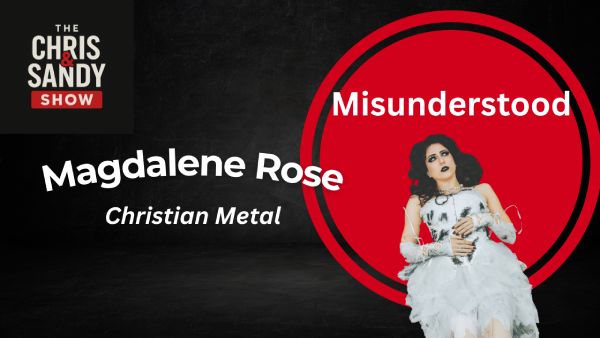
Magdalene Rose is a Christian rock and metal artist whose music combines powerful vocals, deeply personal songwriting, and a mission centered on hope, healing, and faith. Rather than viewing music as entertainment alone, she approaches every song as an opportunity to reach people struggling with identity, mental health, loneliness, and spiritual questions.
Raised in a musical family, Magdalene began performing at a young age alongside her sisters in a Christian rock band. Those formative years taught her not only how to perform but also how music could become a vehicle for ministry. After God led each family member into separate paths, she stepped into a solo career that challenged her to rediscover her identity and calling beyond the band she had always known.
Her debut album, The Heart That Bloomed After Death, reflects that deeply personal journey, exploring themes of redemption, healing, and transformation. Beyond music, Magdalene studied crisis counseling after recognizing the emotional struggles many fans shared during concerts and conversations. That education strengthened her ability to serve people facing depression, anxiety, self-harm, and suicidal thoughts.
Known for blending Christian faith with rock and metal influences, Magdalene has become a voice for those who often feel overlooked by traditional church culture. Her work demonstrates that ministry is not confined to church buildings but can happen anywhere people are searching for hope. Through honesty, compassion, and unwavering faith, she continues building bridges between hurting people and the healing found in Christ.
More Than the Music: How Magdalene Rose Is Using Faith, Healing, and Christian Metal to Reach the People Others Overlook
From discovering her calling as a child to navigating criticism, mental health conversations, and finding her identity beyond a family band, Magdalene Rose reveals why ministry sometimes begins in the places many people avoid.
Music has always been part of Magdalene Rose's life.
Long before recording albums or touring across the country, she was simply a young girl whose parents encouraged their daughters to try music and discover what they loved. Piano lessons became songwriting sessions. Family rehearsals became ministry. Small church performances eventually became years of touring with her sisters in a Christian rock band.
But as she shared during her conversation on The Chris & Sandy Show, the music itself was never the destination.
It was always about people.
That perspective transforms what could have been a standard interview promoting new music into something much more enduring. Throughout the conversation, Magdalene repeatedly returns to themes of identity, purpose, compassion, healing, and meeting hurting people exactly where they are.
Rather than measuring success by streaming numbers or sold-out concerts, she measures it by conversations with young people battling depression, moments of restored hope, and opportunities to introduce someone to the love of Christ.
It's that perspective that makes this interview one of the most thoughtful faith-centered conversations in The Chris & Sandy Show archive.
When a Childhood Passion Became a Calling
Many artists can identify the moment they realized they loved music.
Far fewer can identify the moment they realized music had become a calling.
For Magdalene, that realization developed gradually through years spent making music alongside her sisters. Their parents encouraged each daughter to explore different instruments, allowing them to discover their own interests rather than forcing a predetermined path.
What began with piano lessons eventually expanded into guitar, bass, drums, songwriting, and eventually a family band performing Christian rock music.
Those early years weren't driven by dreams of fame.
They were driven by discovery.
Her father even participated in songwriting sessions, helping shape lyrics while encouraging his daughters to find their own voices. By eleven years old, Magdalene had already played her first live performance.
Looking back, she remembers knowing almost immediately that music would become her life's work.
Not because she loved performing.
Because she sensed it could change lives.
That distinction became one of the defining themes of the interview.
Throughout the conversation, she never separates music from ministry. Instead, she views every song as an opportunity to communicate hope to someone who desperately needs it.
Losing the Band—and Finding Herself
Every meaningful journey includes seasons of unexpected change.
For Magdalene, one of those defining moments came in 2022 when she and her sisters felt God leading each of them in different directions.
Leaving the family band wasn't simply a career transition.
It was an identity crisis.
For years, she had understood herself through familiar roles.
She was a sister.
A band member.
Part of a shared ministry.
Suddenly, those familiar definitions disappeared.
One of the most honest moments of the interview came when she admitted she didn't know who she was outside that environment.
It is an experience that extends far beyond musicians.
Parents experience it after children leave home.
Business owners experience it after selling companies.
Athletes experience it after retirement.
Employees experience it after decades in one career.
Whenever a role that once defined us disappears, we're forced to answer a deeper question:
Who am I when the title is gone?
Rather than resisting that season, Magdalene chose to trust God's direction even without fully understanding where it would lead.
That season ultimately produced her debut album, The Heart That Bloomed After Death—a project rooted in personal testimony rather than performance.
Instead of writing songs to impress listeners, she began writing songs about God's work within her own life.
The result wasn't simply a new album.
It was the beginning of a new identity.
Meeting People Before They Believe
One of the most compelling parts of the conversation centers on Magdalene's decision to pursue crisis counseling.
Many listeners might assume an artist would study music business, production, or performance.
Instead, she chose something entirely different.
While touring, she regularly encountered young people struggling with depression, suicide, anxiety, and hopelessness.
Prayer remained central to her faith.
But she also recognized that some hurting people weren't ready for spiritual conversations.
They still needed help.
Rather than accepting that limitation, she pursued formal education in crisis counseling so she could better understand how to respond when someone shared their deepest pain.
That decision reveals something profound about her approach to ministry.
She doesn't simply want to inspire people.
She wants to equip herself to serve them well.
It's a reminder that compassion isn't only emotional.
Sometimes compassion requires preparation.
Sometimes it requires education.
Sometimes love means developing the skills necessary to meet someone in their darkest moment.
That willingness to grow beyond her comfort zone speaks volumes about her commitment to the people her music reaches.
Looking Beyond Appearances
Perhaps the most widely discussed portion of the interview involves a church that canceled a scheduled concert after leaders objected to Magdalene's appearance.
On the surface, it sounds like a story about controversy.
In reality, it's a conversation about compassion.
Rather than attacking the church or encouraging division, Magdalene continually redirected the discussion toward a larger concern.
She asked listeners to consider the people who already feel rejected.
Teenagers wrestling with self-harm.
Young adults struggling with depression.
People who don't believe they belong inside a church.
Individuals who carry emotional wounds visible only to themselves.
If those people encounter judgment before they encounter grace, many may never return.
For Magdalene, Christian metal isn't about creating a niche genre.
It's about creating a bridge.
She recognizes that many people uncomfortable inside traditional church environments will attend a concert long before they'll attend a Sunday service.
If that concert introduces them to hope, healing, and ultimately to Christ, then the music has fulfilled its purpose.
That philosophy reshapes the entire conversation.
Rather than asking whether churches should embrace heavy music, the interview invites a more meaningful question:
Are we willing to meet people where they are, even when it makes us uncomfortable?
Excellence as Ministry
Another recurring theme throughout the interview is excellence.
Magdalene rejects the assumption that Christian music should settle for being "good enough."
Instead, she believes artists representing Christ should pursue excellence in every area of their work.
That philosophy influences songwriting.
Production.
Performances.
Relationships with fans.
Social media.
Touring.
Even answering messages.
She describes personally responding to supporters because she wants every individual to know they matter.
She talks about helping set up merchandise tables.
Loading equipment.
Booking shows.
Recording music.
Managing countless responsibilities that audiences rarely see.
Like many independent artists, there is no large corporate team handling every detail behind the scenes.
The work continues long after the lights go down.
Yet she speaks about those responsibilities without resentment.
Instead, they become another opportunity to serve.
It's a refreshing reminder that genuine leadership often looks less glamorous than people imagine.
Great ministries—and great careers—are frequently built through ordinary acts of consistency rather than extraordinary moments of recognition.
7 Lessons We Learned From Magdalene Rose
Lesson 1: Your Calling Will Eventually Become Bigger Than Your Comfort Zone
Many people discover their purpose in familiar places. The real test comes when that purpose asks them to leave those places behind.
For Magdalene Rose, that moment arrived when her family's Christian rock band came to an end. It wasn't simply the loss of a musical project—it was the loss of an identity she had carried since childhood. She openly admitted that she didn't know who she was outside of being a sister and a band member. For anyone who has ever left a career, graduated from school, experienced retirement, or watched a chapter of life close, that feeling is deeply familiar.
Yet this conversation reminds us that God often expands our vision by first disrupting our comfort. Had Magdalene remained where she was, she might never have discovered the ministry that would emerge through her solo career. What initially felt like loss became preparation for something larger.
Too often we mistake familiar for faithful. But growth frequently begins when we trust God's direction before we understand His destination. The seasons that feel most uncertain are often the ones where our identity becomes anchored less in what we do and more in who we are.
Lesson 2: Compassion Is Strongest When It Is Equipped
One of the most surprising moments in the interview wasn't about music at all.
It was Magdalene's explanation for why she pursued crisis counseling.
As she toured, people began approaching her with stories of depression, anxiety, suicidal thoughts, and overwhelming emotional pain. She believed deeply in the power of prayer, but she also recognized something important: sometimes hurting people need someone who knows how to walk with them through crisis before they are ready for deeper spiritual conversations.
Instead of accepting her limitations, she chose to prepare herself.
That decision reveals an often-overlooked truth about leadership. Good intentions matter, but preparation matters too. Compassion grows even stronger when it is paired with wisdom, education, and practical skills.
Whether someone leads a church, owns a business, raises children, or serves their community, the principle remains the same. Loving people well often requires continual learning. The more equipped we become, the more effectively we can help those who are hurting.
Lesson 3: Never Judge a Story by Its Appearance
The canceled church concert became one of the defining moments of the interview, but not because of controversy.
It became significant because it exposed how quickly people can form conclusions before taking time to understand someone's heart.
Magdalene shared that the event wasn't canceled because of lyrics, behavior, or theology. Instead, it stemmed largely from assumptions based on appearance. Her clothing, makeup, and style became enough for some to question her faith without ever hearing her testimony or her music.
That experience invites every reader to examine a difficult question:
How often do we unknowingly do the same thing?
Judging by appearances has existed throughout history, but the Gospel repeatedly challenges that instinct. Jesus consistently looked beyond the surface, seeing value where others saw rejection.
This lesson reaches far beyond church culture. In workplaces, neighborhoods, schools, and everyday life, people carry stories invisible to everyone else. Choosing curiosity over assumption may become one of the greatest acts of compassion we ever practice.
Lesson 4: Purpose Is Found in People, Not Platforms
Throughout the interview, Magdalene rarely talked about growing an audience.
She talked about helping people.
That distinction says everything.
She described answering messages personally, responding to comments, speaking with young women struggling with mental health, and doing everything possible to ensure people felt seen. Even questions about clothing received the same level of attention as conversations about emotional pain because, in her words, every person mattered.
In today's digital culture, it's easy to reduce success to numbers—followers, subscribers, ticket sales, streams, or engagement. Yet Magdalene's approach reminds us that influence has always been measured one relationship at a time.
Platforms create opportunities.
People create purpose.
The healthiest leaders never allow the size of their audience to become more important than the individuals within it.
Lesson 5: Sometimes the Best Ministry Happens Outside Traditional Walls
One of the interview's most thoughtful ideas centered around the purpose of Christian metal.
For some listeners, the genre itself may seem unusual. Magdalene understands that.
But her explanation shifted the conversation entirely.
She isn't trying to replace churches.
She's trying to build a bridge toward them.
Many of the people she encounters feel uncomfortable walking into a church building because of past experiences, personal struggles, or fear of rejection. A concert often becomes the first place where they experience acceptance, community, and conversations about hope.
That insight carries an important reminder for all of us.
Ministry has never been limited to one location.
It happens in coffee shops.
Schools.
Workplaces.
Concert venues.
Neighborhoods.
Social media conversations.
Hospital rooms.
Living rooms.
God has always met people wherever they are. Followers of Christ are called to do the same.
Lesson 6: Excellence Is an Act of Worship
Magdalene spoke passionately about refusing to settle for mediocrity simply because her music carries a Christian message.
Instead, she believes representing Christ should inspire artists to pursue excellence at the highest level.
That philosophy extends well beyond music.
She described booking shows, answering emails, loading equipment, running merchandise tables, recording songs, managing social media, and responding to supporters. None of those responsibilities are glamorous, yet each one contributes to the larger mission.
Excellence is rarely found in one extraordinary moment.
It is built through thousands of ordinary decisions made consistently over time.
Whether someone is writing books, teaching children, leading employees, serving customers, or raising a family, excellence communicates respect—for the work itself, for the people being served, and ultimately for the God who entrusted that work to us.
Lesson 7: Healing Becomes More Powerful When It Is Shared
Perhaps the greatest thread connecting this entire interview is Magdalene's willingness to speak openly about what God has done in her own life.
Her songs are not abstract ideas.
They are personal testimonies.
She writes about healing because she has experienced healing.
She writes about hope because she has encountered hope.
She speaks about freedom because she believes freedom is possible.
That authenticity gives her message credibility.
People are often inspired less by perfection than by honesty.
Our greatest influence frequently comes from the very places where we once struggled.
When we allow God to redeem our pain, our wounds can become someone else's roadmap toward healing. That doesn't erase the hardship, but it gives it purpose. As Magdalene's story demonstrates, redeemed pain often becomes the strongest platform for lasting hope.
The Single Biggest Lesson From This Interview
If someone remembers only one lesson from this conversation five years from now, it should be this:
Never let outward appearances prevent you from seeing the image of God in another person.
Everything about Magdalene Rose's ministry flows from that conviction. Whether she is performing in churches, clubs, festivals, or recovery events, her goal is not to challenge traditions for the sake of controversy. Her goal is to ensure that people who feel rejected still have an opportunity to encounter hope, healing, and the love of Christ.
That lesson extends beyond faith communities. Every day we encounter people whose stories we do not know. Some carry grief, addiction, depression, anxiety, trauma, loneliness, or fear behind smiles that reveal nothing. When we choose compassion over assumptions, we create space for healing to begin.
Five years from now, album releases may fade from memory. Tour dates will pass. Social media algorithms will change.
But the challenge to love people before judging them will remain timeless.